




The Ultimate Guide to Building a Nootropic Stack in 2026
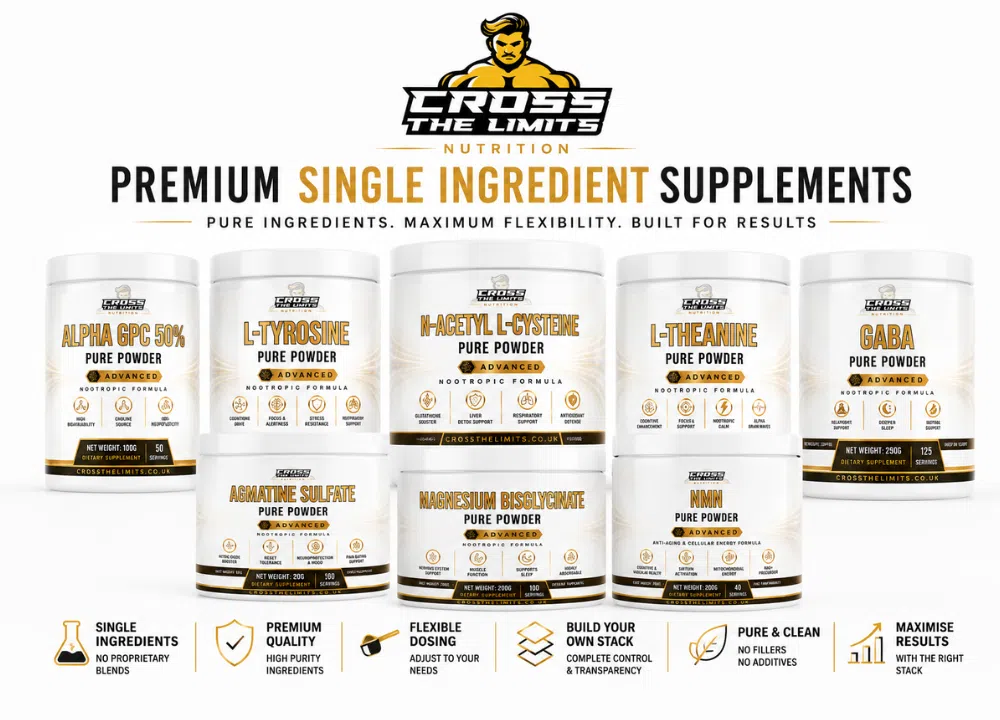
If you’re looking for premium single ingredient supplements instead of complicated proprietary blends, Cross The Limits Nutrition was built for exactly that purpose. Our philosophy is simple: use high-quality ingredients, transparent dosages, and complete flexibility so you can build a supplement stack that matches your personal goals rather than relying on one-size-fits-all formulas.
Unlike many supplement brands that combine numerous ingredients into proprietary blends, Cross The Limits Nutrition supplements are designed around carefully selected single ingredients. This approach gives you complete control over your daily supplementation, allowing you to combine products for focus, cognitive performance, recovery, sleep, longevity, sports nutrition, or general wellbeing without paying for unnecessary fillers or hidden dosages.
Cross The Limits Nutrition at a Glance
| Feature | Details |
|---|---|
| Brand | Cross The Limits Nutrition |
| Specialisation | Premium Single Ingredient Supplements |
| Product Types | Nootropics, Recovery, Wellness & Sports Nutrition |
| Formula Philosophy | Transparent Ingredients & No Proprietary Blends |
| Supplement Format | Pure Powders |
| Best For | Personalised Supplement Stacks |
| Suitable For | Athletes, Students, Professionals, Biohackers |
| Core Values | Purity, Quality, Transparency & Flexibility |
Whether you’re a student preparing for exams, an athlete recovering from intense training, an entrepreneur working long hours, or simply someone interested in optimising daily performance, building your own supplement stack provides far greater flexibility than relying on fixed formulas. Premium powders also make it easier to adjust serving sizes, personalise your routine, and create combinations that evolve with your goals.
This complete guide explains everything you need to know about Cross The Limits Nutrition, including why we created the brand, why single ingredient supplements continue to grow in popularity, how to build effective supplement stacks, and which products work best together. You’ll also discover practical stacking examples, comparison tables, frequently asked questions, and expert recommendations to help you get the most from your supplementation.

What is a nootropic stack and how does it work?
A nootropic stack is a tailored blend of cognitive-supporting ingredients designed to achieve a specific outcome. It works by engaging complementary systems — acetylcholine for memory, catecholamines for motivation and focus, and GABA/glutamate balance for calm, attentive states. A well-designed stack prioritises synergy, low risk, and steady, measurable gains over short-lived stimulation.
In practice, a good stack focuses on a handful of well-supported components rather than many unproven ones. Common anchors include choline sources (Alpha GPC or CDP choline) for memory and L-theanine to smooth focus. For high-pressure tasks, L-tyrosine or NALT can help sustain dopamine and norepinephrine levels, while magnesium supports neuronal stability and restorative sleep.
Design uses systems thinking: pick one goal, create a foundation, and add items only if your tracking justifies them. Typical pathways target acetylcholine for encoding, catecholamines for drive, adenosine modulation via caffeine for alertness, NAC for glutathione and recovery, and GABAergic tone for relaxation.
Which Cross The Limits Nutrition Supplement Should You Choose?
| Your Goal | Recommended Product |
|---|---|
| Improve Focus | Alpha GPC |
| Better Memory | CDP Choline |
| Increase Motivation | L-Tyrosine |
| Support Dopamine | N-Acetyl L-Tyrosine |
| Calm Focus | L-Theanine |
| Better Sleep | GABA |
| Muscle Recovery | Magnesium Bisglycinate |
| Liver Support | NAC + Milk Thistle |
| Cellular Health | NAC |
| Longevity | NMN + NAC |
How to define goals and set a baseline before you start?
Begin by choosing one specific cognitive goal and recording a baseline. Narrow objectives simplify decisions and reduce risk; a baseline shows whether your stack makes a difference. Track sleep, workload, mood, and focus for two weeks to spot bottlenecks before adding supplements. For example, log the start and end times of focused sessions, the number of distractions per hour, and a morning reaction-time score to quantify change; this empirical habit is central to an Ultimate • Complete • Advanced • Science-Based • Expert Guide approach to a nootropic stack. Treat the baseline as your control in a simple nootropic protocol so you can later compare the effects of choline sources, L-theanine, or L-tyrosine without confounding variables.
Make goals operational. Examples: “maintain focused work for 90 minutes,” “reduce test anxiety,” or “improve recall while learning languages.” Use 2–3 repeatable daily metrics: sustained attention tasks, reading speed with comprehension checks, or a simple reaction-time test. Add subjective ratings for stress, energy, and calm. You can use free apps or a spreadsheet to track these metrics — e.g., a 5-minute Go/No-Go test each morning plus a short comprehension quiz after a reading block — which makes it easier to judge whether the best supplements for focus and memory are actually moving the needle. Keep your metric choices aligned with your cognitive enhancement plan so that when you begin to build a nootropic stack safely, each addition targets a measurable deficit.
Capture context too: sleep duration and quality, caffeine intake, hydration, and exercise. Small controls — consistent wake times, regular light exposure, steady meal timing — often produce measurable gains before any supplement. This disciplined prework fits an Ultimate • Complete • Advanced • Science-Based • Expert Guide approach and underpins a practical cognitive enhancement plan. Also note medication timing, menstrual cycle or stress events, and any prior supplement use — these contextual flags help you interpret effects from an advanced brain supplement regimen and prevent misattributing natural variation to a nootropic intervention.
Nootropic stack step by step: Ultimate • Complete • Advanced • Science-Based • Expert Guide approach
Build gradually: foundation first, targeted additions next, then validation. Start with sleep, hydration, and nutrition; add one compound at a time; and test each for about two weeks. Keep the ingredient list lean — synergy beats complexity, and patience reduces the risk of side effects. For example, prioritise a protein-rich breakfast, consistent morning light exposure, and electrolyte intake during long workdays before reaching for supplements; these steps often move metrics more than adding another pill. When you introduce a new compound, pick a single outcome to watch (e.g., sustained attention or recall), so the signal is clearer.
Step 1: stabilise sleep and stress. Step 2: Add a choline source to support memory. Step 3: If you use caffeine, pair it with L-theanine for smoother alertness. Step 4: add L-tyrosine or NALT for acute stress or high-pressure tasks. Step 5: Consider NAC and magnesium for resilience and recovery. Concretely, Step 1 can include a 30–60-minute wind-down routine, blackout curtains, and a consistent wake time; Step 2 might be Alpha GPC 300–600 mg or CDP choline 250–500 mg, tested on separate weeks. For Step 3, use a typical caffeine:L-theanine ratio like 1:2 (e.g., 100 mg caffeine + 200 mg L-theanine) and assess jitteriness and focus within the first hour. For Steps 4–5, trial low L-tyrosine doses (e.g., 250–500 mg) around stress windows, and prefer magnesium glycinate or threonate in the evening, while using NAC earlier in the day if resilience is the target.
Keep a change log. Record dose, form, timing, effects at 60 minutes and 4 hours, and any impact on sleep or mood. A best-practice workflow is: set a baseline; introduce one variable; collect data; decide to keep, adjust, or remove; then retest. That is the practical nootropic protocol approach and a reliable method for building a nootropic stack safely. Useful extras: timestamped notes, a simple spreadsheet with column flags for “improved,” “no change,” or “worse,” and a rule — keep an ingredient only if it meaningfully improves two or more metrics over baseline. Also log potential confounders (late caffeine, illness, travel) so you don’t misattribute short-term noise to a supplement effect.
Why Choose Cross The Limits Nutrition?
| Cross The Limits Nutrition | Typical Supplement Brand |
|---|---|
| ⭐ Transparent ingredient labels | ❌ Proprietary blends |
| ⭐ Single-ingredient formulas | ❌ Fixed combinations |
| ⭐ Flexible daily dosing | ❌ Limited serving flexibility |
| ⭐ Premium raw materials | ❌ Mixed ingredient quality |
| ⭐ Easy stack building | ❌ Difficult to customise |
| ⭐ No unnecessary fillers | ❌ Often contains fillers |
| ⭐ High serving counts | ❌ Fewer servings per container |
| ⭐ Built for personalised supplementation | ❌ One-size-fits-all approach |
Alpha GPC vs CDP choline: which should you choose?
Alpha GPC and CDP choline both elevate acetylcholine, but feel different. Alpha GPC is a potent choline donor and can deliver rapid memory improvements. CDP choline (citicoline) also provides cytidine, which converts to uridine and may support membrane health and dopamine tone. In an Ultimate • Complete • Advanced • Science-Based • Expert Guide approach to a nootropic stack, understanding these mechanistic differences helps you match a choline source to your cognitive enhancement plan rather than picking by hype. For example, if your nootropic protocol prioritises fast encoding for study sessions, Alpha GPC’s rapid availability can be an asset within a broader advanced brain supplement regimen.
Choose Alpha GPC for crisp encoding and if you react poorly to stimulants. Many users report clearer recall and fewer choline-depletion headaches during intense study. Opt for CDP choline if you want broader phospholipid support or are pairing it with stimulants and L-tyrosine for sustained motivation. In practice, pairing CDP choline with L-tyrosine and a modest caffeine:L-theanine combo can favour longer-lasting drive without the abrupt peaks some stimulants produce; that combination often appears in recommendations for the best supplements for focus and memory.
Practical tips: test each form for at least a week; avoid taking both together unless necessary; and schedule doses earlier in the day to aid learning and prevent sleep disruption. Track which form improves your metrics — that data-driven habit is central to an advanced brain supplement regimen. When logging results as part of how to build a nootropic stack safely, note timing relative to meals, caffeine, and L-theanine use, and include both objective measures (reaction time, recall) and subjective scales so your choice of choline source is grounded in measurable improvement.
Daily Supplement Schedule
| Time of Day | Suggested Supplements | Purpose |
|---|---|---|
| Morning | Alpha GPC + CDP Choline | Memory & focus |
| Before Work | L-Tyrosine or NALT | Productivity & mental performance |
| Before Training | Agmatine Sulfate + L-Tyrosine | Workout focus |
| Afternoon | L-Theanine | Calm concentration |
| Evening | NAC | Antioxidant support |
| Before Bed | Magnesium + GABA | Relaxation & recovery |
How much L-tyrosine, NALT, caffeine, and L-theanine?
Use conservative, evidence-informed ranges and titrate slowly. L-tyrosine has strong support for stress performance; many protocols start low and increase as demand rises. NALT is an alternative, though some evidence favours plain L-tyrosine. Always pair caffeine with L-theanine to reduce jitters and smooth arousal. For a beginner nootropic stack, that might mean starting L-tyrosine at 150–250 mg and increasing in 100 mg steps only after tracking several successful trials; keep notes on timing relative to meals and acute stressors so you can link cause and effect.
Illustrative patterns (not medical advice): caffeine 50–150 mg with L-theanine 100–200 mg for focused, calm alertness. For intense cognitive stress, users often trial L-tyrosine in the low hundreds of milligrams. Try NALT only if you don’t respond to plain L-tyrosine, and validate with your tracking. Example regimens used in advanced brain supplement regimens include 100 mg caffeine + 200 mg L-theanine before a morning work block, and 300 mg L-tyrosine before an exam or presentation; log both performance metrics and subjective calm to evaluate whether the nootropic stack is helping.
Rules of thumb: avoid escalating on poor-sleep days; don’t combine multiple stimulants; and cap daily caffeine to prevent rebound fatigue. Run A/B weeks. The objective is steady focus, not spikes — the core of how to build a nootropic stack safely. Practically, set a personal caffeine ceiling (for many people, 200–300 mg/day) and schedule deliberate deloads (48–72 hours) every few weeks to check tolerance and preserve sensitivity, which keeps your cognitive enhancement plan sustainable.
NAC, magnesium, and GABA: when and why to add them?
Introduce recovery agents when stress, irritability, or sleep problems limit progress. NAC supports glutathione synthesis and may reduce mental fatigue or compulsive tendencies; it also modulates glutamatergic signalling, which can help during heavy cognitive load. Magnesium aids relaxation, NMDA balance, and sleep — different salts have different effects on absorption and GI tolerance. Oral GABA can promote calm for some, although its brain penetration is debated; some users report benefit from low evening doses even if central penetration is limited, suggesting peripheral or vagal mechanisms.
A NAC-focused component is useful during intense work periods or when stimulant use is high, and many protocols recommend trying 600 mg once or twice daily while tracking outcomes. Many prefer NAC earlier in the day to avoid potential interference with evening sleep cycles; note that splitting doses can smooth effects across a workday in an advanced brain supplement regimen. Magnesium glycinate or threonate is common for evening wind-down — typical starting ranges are 100–300 mg elemental magnesium at night, with threonate often favoured when cognitive recovery and sleep architecture are the target. If you try GABA, start low (e.g., 100–250 mg) and watch for next-day grogginess; combine with a consistent bedtime routine and avoid mixing with other sedatives until you know your response.
Safety first: consult a clinician if you take prescriptions, have asthma, blood pressure issues, or mood disorders, and flag any potential interactions in your nootropic protocol before adding these agents. NAC can interact with nitroglycerine and may affect certain chemotherapy agents or immune-modulating drugs, so check with a provider; magnesium can cause loose stools at higher doses and should be reduced or switched to a different salt if tolerated poorly. GABA may affect blood pressure or interact with benzodiazepines and other CNS depressants, so keep doses conservative, log objective sleep and next-day cognition metrics, and prioritise sleep over constant stimulation as you iterate an advanced brain supplement regimen.
How to test, track, and iterate your stack like a scientist?
Run simple, repeatable experiments: change one variable at a time, keep it for 7–14 days, and compare to baseline. Use objective attention and recall tasks, plus subjective energy, stress, and calm scales. Seek clear signals, not perfection. For example, when testing L-tyrosine for a high-pressure presentation, run two identical workblocks, one week on your usual routine and one week with the supplement, then compare reaction times and self-rated calm. That single-variable contrast is central to an Ultimate • Complete • Advanced • Science-Based • Expert Guide approach to a nootropic stack. Log dosage, timing, and any concomitant choline sources or L-theanine use so you can separate interaction effects and follow a proper nootropic protocol rather than anecdote-driven changes.
A practical kit: a reaction-time app, a brief working-memory task, a deep-work timer, and a daily sleep score. Add context markers such as resting heart rate, step count, and caffeine intake. Rate each day for focus (1–5) and calm (1–5) to capture trade-offs. Include concrete tools — for instance, a 5-minute n-back test for working memory, a Pomodoro timer for sustained-attention blocks, and an automated sleep tracker or a simple sleep diary — and tie them to your cognitive enhancement plan so that results are comparable over weeks. Track whether pairing caffeine with L-theanine changes your jitteriness score or if switching choline sources alters recall, which helps identify the best supplements for focus and memory within an advanced brain supplement regimen.
Every two weeks, review: keep elements that meaningfully move two or more metrics; drop those that don’t. Cycle stimulants to limit tolerance and schedule deload weeks. These rituals reflect an Ultimate • Complete • Advanced • Science-Based • Expert Guide ethos — rigor, restraint, and repeatability — and form the backbone of a cognitive enhancement plan. Operationalise “meaningfully” with thresholds (e.g., a 5–10% improvement in reaction time or a consistent +1 point on the focus rating across four out of five sessions) and document decisions in a nootropic protocol log so you can justify retaining a compound like Alpha GPC or tweaking doses of L-theanine. Over months, this disciplined iteration shows how to build a nootropic stack safely and reveals which combinations truly support sustained performance.
Most common mistakes when building a nootropic stack
Common errors include adding too many ingredients at once and prioritising novelty over results. Complexity obscures cause and effect; mixing stimulants increases adverse effects. Another mistake is treating poor sleep with more stimulants rather than fixing sleep hygiene and the circadian rhythm. For example, introducing a new racetam, a stimulant, and a herbal adaptogen in the same week makes it impossible to follow a science-based nootropic protocol; instead, you won’t know which change moved your metrics. In an Ultimate • Complete • Advanced • Science-Based • Expert Guide approach to a nootropic stack, prioritise fixing lifestyle drivers (sleep timing, light exposure) before layering compounds from an advanced brain supplement regimen.
Don’t neglect the basics: hydration, electrolytes, adequate protein, and light exercise. Missing choline can cause headaches with racetams or heavy study. Timing matters — late caffeine hurts sleep; late theanine can blunt focus. Also consider small practical checks: measure morning body weight to track hydration trends, include a protein source within an hour of waking to stabilise neurotransmitter precursors, and schedule a brief midafternoon walk to reset attention without stimulants. These low-cost interventions often move your cognitive enhancement plan more than adding another capsule and make subsequent testing of the best supplements for focus and memory far more interpretable.
Use guardrails: limit testing to three compounds; keep a one-page protocol; and run A/B weeks. If anxiety increases, simplify. If sleep suffers, prioritise magnesium, theanine, and schedule over adding another supplement. Concrete rules speed decisions — for example, set a hard daily caffeine ceiling, require two positive metrics before retaining an ingredient, and plan monthly deloads to reset tolerance. This disciplined framework is central to building a nootropic stack safely and keeps it lean, effective, and sustainable over months.
Cross The Limits Nutrition Stack Builder
| Need | Best Product | Difficulty |
|---|---|---|
| Focus | Alpha GPC | ⭐ |
| Memory | CDP Choline | ⭐ |
| Motivation | L-Tyrosine | ⭐⭐ |
| Productivity | NALT | ⭐⭐ |
| Calmness | L-Theanine | ⭐ |
| Sleep | GABA | ⭐ |
| Recovery | Magnesium | ⭐ |
| Liver Support | NAC | ⭐ |
| Longevity | NMN | ⭐⭐⭐ |
| Advanced Stack | Combine Multiple Products | ⭐⭐⭐⭐⭐ |
Frequently Asked Questions About Building a Nootropic Stack
What is a nootropic stack?
A nootropic stack is a combination of carefully selected supplements used to support specific cognitive goals such as focus, memory, mental energy, stress resilience, learning, and productivity. Instead of relying on a single ingredient, many users combine complementary compounds that work through different biological pathways to create a personalised supplementation strategy.
What are the best supplements for focus and concentration?
Some of the most popular ingredients include Alpha GPC, CDP Choline, L-Tyrosine, N-Acetyl L-Tyrosine (NALT), L-Theanine, and caffeine. The ideal combination depends on your goals, workload, sleep quality, and personal response to each ingredient.
How do I build a beginner nootropic stack?
Start with one clear goal and introduce one supplement at a time. Many beginners begin with a choline source such as Alpha GPC or CDP Choline, add L-Theanine for calm focus, and only later include ingredients such as L-Tyrosine or NAC if additional support is needed.
Which is better: Alpha GPC or CDP Choline?
Both are excellent sources of choline but have slightly different characteristics. Alpha GPC is often chosen for rapid acetylcholine support and cognitive performance, while CDP Choline also provides cytidine, which contributes to phospholipid synthesis and overall brain cell support. Many experienced users test both separately before deciding which works best for them.
What is the difference between L-Tyrosine and N-Acetyl L-Tyrosine (NALT)?
L-Tyrosine is the standard amino acid commonly used to support dopamine production during periods of stress and mental demand. NALT is a modified, highly water-soluble form that mixes easily into drinks and is frequently included in advanced nootropic stacks.
Can I combine multiple nootropic supplements together?
Yes. Many experienced users combine complementary ingredients to build personalised stacks. Popular combinations include Alpha GPC with L-Tyrosine, CDP Choline with L-Theanine, or Magnesium with GABA for evening support. Introducing one new ingredient at a time makes it easier to evaluate individual results.
Should I take nootropic supplements every day?
Daily use depends on the ingredient and your goals. Some supplements are commonly taken every day, while others are reserved for periods of intensive studying, demanding work, or athletic performance. Many users also include occasional break days to assess long-term effectiveness.
What is the best nootropic stack for studying?
A popular study stack includes Alpha GPC or CDP Choline combined with L-Theanine and, if appropriate, a moderate amount of caffeine. Some users also include L-Tyrosine during periods of prolonged mental stress or exam preparation.
Which supplements support productivity without excessive stimulation?
For users seeking improved focus without relying on high stimulant doses, ingredients such as L-Theanine, Alpha GPC, CDP Choline, Magnesium Bisglycinate, and NAC are frequently used to support concentration, mental clarity, and balanced cognitive performance.
Can beginners use single-ingredient supplements?
Yes. Single-ingredient supplements are often preferred by beginners because they offer transparent dosing and allow users to build personalised stacks gradually, rather than relying on large proprietary blends with fixed ingredient combinations.
Why are single-ingredient supplements becoming more popular?
Single-ingredient supplements offer complete transparency, flexible dosing, and easier stack customisation. They allow users to combine only the ingredients they need while avoiding unnecessary fillers and proprietary blends.
Where can I build a complete nootropic stack?
Cross The Limits Nutrition offers a growing range of premium single-ingredient supplements designed to help users build personalised stacks for focus, memory, productivity, recovery, sleep, longevity, sports performance, and everyday wellness, all made with transparent, high-quality ingredients.
Cross The Limits Nutrition Product Categories
| Category | Primary Goal | Popular Ingredients | Best For |
|---|---|---|---|
| Brain Performance | Focus & Memory | Alpha GPC, CDP Choline | Students, professionals |
| Mental Performance | Motivation & Productivity | L-Tyrosine, NALT | Entrepreneurs, gamers |
| Calm Focus | Relaxation Without Sedation | L-Theanine | Daily productivity |
| Sleep & Recovery | Evening Wellness | GABA, Magnesium Bisglycinate | Better recovery |
| Antioxidant Support | Cellular Protection | NAC | Everyday wellness |
| Liver Health | Liver Support | Milk Thistle, NAC | Wellness protocols |
| Sports Performance | Training Support | Agmatine Sulfate, Tyrosine | Athletes |
| Longevity | Healthy Ageing | NMN, NAC, Magnesium | Biohackers |
Summary and next steps
A successful nootropic approach is simple, goal-driven, and validated by your own data. Start with sleep and routine, add a choline source, pair caffeine with L-theanine if you use caffeine, and consider L-tyrosine, NAC, magnesium, or GABA based on your bottlenecks. Test, track, and iterate methodically to identify the best supplements for focus and memory.
Always put safety first: consult a qualified clinician if you have health conditions, take medication, or are pregnant or breastfeeding. Use conservative ranges, change one variable at a time, and protect sleep. This disciplined process reflects the standard of an Ultimate • Complete • Advanced • Science-Based • Expert Guide and supports a reliable, advanced brain supplement regimen.
Ready to build yours? Define one goal now, take a two-week baseline, and set a three-compound testing plan. With clear metrics and steady iteration, you can create a lean, dependable nootropic stack that supports work and wellbeing without guesswork or unnecessary risk.