



How Long Does F-Phenibut Last? Onset, Duration & Half-Life

How long does F-Phenibut last? This is one of the most frequently asked questions by people researching advanced GABA-B compounds. Compared with traditional Phenibut, many users describe F-Phenibut as having a faster onset, a shorter overall duration, and a cleaner, more predictable effect profile. Read on to discover its timeline, half-life, and the factors that influence its effects so you can plan more responsibly and avoid common mistakes associated with GABAergic compounds!
Key Takeaways
- Most users report F-Phenibut lasting around 6–10 hours.
- Peak effects usually occur between 2 and 4 hours.
- F-Phenibut is commonly described as having a faster onset than Phenibut.
- Heavy meals may delay absorption and peak effects.
- Frequent use greatly increases tolerance risk.
- Avoid combining F-Phenibut with alcohol or other CNS depressants.
- Understanding your own response is more valuable than copying other users.
- Responsible use and long breaks between sessions produce the most consistent results.
How long does F-Phenibut last?
| Quick Answer | Typical User Reports |
|---|---|
| First noticeable effects | 30–90 minutes |
| Peak effects | 2–4 hours |
| Reported duration | 6–10 hours |
| Estimated half-life | Approximately 3.5–6.5 hours |
| Best suited for | Daytime relaxation, social confidence, calm focus |
| Daily use recommended? | ❌ No |
What Is F-Phenibut and Why Does Its Duration Matter?
F-Phenibut (Fluorophenibut) is a fluorinated analogue of Phenibut that primarily acts on GABA-B receptors. Many experienced users report that it produces a noticeably faster onset, a cleaner peak, and a shorter overall duration than traditional Phenibut, making it easier to fit into daytime routines and social situations. While human clinical research remains limited, consistent user reports and current pharmacological understanding suggest that the fluorine modification influences both absorption and the overall time course of its effects.
Unlike classic Phenibut, which can sometimes take several hours before noticeable effects develop, F-Phenibut is often described as reaching effective levels much sooner. Many users report reduced anxiety, smoother communication, improved social confidence, and a calmer mental state while maintaining better daytime functionality. Because timing plays such an important role, understanding onset, peak effects, and elimination is often just as important as understanding dosage itself.
| F-Phenibut at a Glance | Details |
|---|---|
| Main mechanism | Primarily a GABA-B receptor agonist |
| Typical onset | 30–90 minutes |
| Peak effects | 2–4 hours |
| Typical duration | 6–10 hours |
| Estimated half-life | 3.5–6.5 hours |
| Research quality | ★★☆☆☆ Limited human data |
How Long Does F-Phenibut Last? Onset, Duration and Half-Life Explained
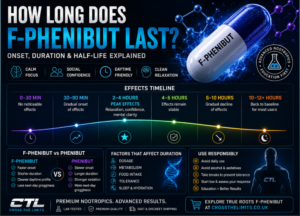
Most experienced users report that F-Phenibut begins working within approximately 30–90 minutes, particularly when taken on an empty or lightly filled stomach. Peak effects are commonly described between two and four hours after administration, followed by a gradual decline over the next several hours. Although experiences vary among individuals, many users report that the most noticeable effects last for 6–10 hours before gradually returning to baseline.
Current estimates place the F-Phenibut half-life somewhere between approximately 3.5 and 6.5 hours, although robust human pharmacokinetic studies remain limited. Factors such as body weight, metabolism, meal timing, hydration, kidney function, previous Phenibut exposure, and individual sensitivity can all influence how quickly the compound is absorbed and eliminated. This explains why one person’s experience may differ significantly from another’s despite taking similar amounts.
| Typical F-Phenibut Timeline | What Users Commonly Report |
|---|---|
| 0–30 minutes | No noticeable effects |
| 30–90 minutes | Gradual onset begins |
| 2–4 hours | Peak relaxation, calmness and sociability |
| 5–8 hours | Effects gradually taper |
| 8–10 hours | Most users feel close to baseline |
| Next day | Generally fewer residual effects than Phenibut |
One of the biggest advantages frequently mentioned by experienced users is predictability. Compared with traditional Phenibut, F-Phenibut is often considered easier to schedule around work, meetings, presentations, or social events because its faster onset and shorter duration provide a more defined window of effects. Rather than focusing only on the reported half-life, it is usually more practical to understand your own personal timeline by keeping notes on meal timing, hydration, caffeine intake, sleep quality, and the time at which effects begin, peak, and gradually fade.
What Factors Affect How Long F-Phenibut Lasts?
Although many users ask exactly how long F-Phenibut lasts, there is no single answer that applies to everyone. The duration of effects depends on several variables, including meal timing, metabolism, body weight, hydration, previous Phenibut use, individual sensitivity, and overall health. Even when two people use the same product, their experience may differ by several hours.
Among all influencing factors, food is one of the most important. Many experienced users report a noticeably faster onset when F-Phenibut is taken on an empty stomach or after a light meal. Heavy, high-fat meals may delay absorption by one to two hours and often produce a smoother but less pronounced peak. Hydration, sleep quality, caffeine intake, and previous GABAergic exposure can also change how quickly effects develop and how long they remain noticeable.
| Factor | Impact on Duration | Importance |
|---|---|---|
| Heavy meals | Slower onset and delayed peak | ★★★★★ |
| Empty stomach | Faster absorption | ★★★★★ |
| Tolerance | Shorter and weaker effects | ★★★★★ |
| Hydration | May improve consistency | ★★★★☆ |
| Sleep quality | Can influence perceived intensity | ★★★★☆ |
| Caffeine | May increase alertness while masking sedation | ★★★☆☆ |
Tolerance is another major factor that changes both onset and duration. Users who take F-Phenibut or traditional Phenibut frequently often report a flatter peak, weaker relaxation, and shorter-lasting effects. Rather than increasing the amount, many experienced users recommend extending the time between sessions, allowing sensitivity to recover naturally.
How Can You Time F-Phenibut for the Best Results?
Timing F-Phenibut correctly is often more important than changing the amount used. Because most users report peak effects between two and four hours after administration, planning around the activity rather than the clock usually produces more predictable results. Whether your goal is social confidence, focused work, or evening relaxation, understanding your personal timeline helps minimise unwanted surprises.
| Goal | Recommended Timing |
|---|---|
| Business meetings | Allow enough time for peak effects to take effect before the meeting begins. |
| Public speaking | Plan so peak confidence matches your presentation. |
| Social events | Aim to reach peak effects shortly after arriving. |
| Focused work | Schedule deep work during the reported peak window. |
| Evening relaxation | Allow effects to taper well before bedtime. |
Many experienced users recommend keeping meals light beforehand and avoiding alcohol throughout the day. Rather than adjusting several variables at once, keep sleep, caffeine intake, hydration, and meal timing as consistent as possible. This makes it much easier to identify your own personal onset, peak, and duration without unnecessary variability.
F-Phenibut vs Phenibut: Which One Lasts Longer?
One of the most common comparisons is between F-Phenibut and traditional Phenibut. While both compounds primarily target GABA-B receptors, many users describe noticeably different timelines. F-Phenibut is generally reported to produce a quicker onset, a more defined peak, and a shorter overall duration, whereas traditional Phenibut often develops more slowly but remains noticeable for considerably longer.
| Feature | F-Phenibut | Phenibut |
|---|---|---|
| Reported onset | 30–90 minutes | 2–4 hours |
| Peak effects | 2–4 hours | 3–6 hours |
| Typical duration | 6–10 hours | 8–14+ hours |
| Next-day grogginess | ★★☆☆☆ | ★★★★☆ |
| Daytime suitability | ★★★★★ | ★★★☆☆ |
Many users choose F-Phenibut specifically because its shorter duration makes it easier to fit around work, travel, business meetings, or social occasions without experiencing prolonged after-effects. Others continue to prefer traditional Phenibut for longer-lasting relaxation or evening use. Neither approach is universally better—the most suitable option depends on your schedule, personal response, and previous experience with GABAergic compounds.
Read: Best Mitochondrial Supplement in 2026? Koka Labz Mitogenesis PRO Review
How Does F-Phenibut Compare to Baclofen and Gabapentin?
Although F-Phenibut is frequently compared with Baclofen and Gabapentin, these compounds serve different purposes. Baclofen is a prescription medication primarily used to treat muscle spasticity and acts as a potent GABA-B receptor agonist. Gabapentin works primarily by modulating alpha-2-delta calcium channels and produces a distinct overall neurological profile.
| Compound | Main Mechanism | Most Common Use |
|---|---|---|
| F-Phenibut | GABA-B receptor agonist | Relaxation, sociability, calm focus |
| Phenibut | GABA-B receptor agonist | Longer-lasting relaxation |
| Baclofen | Prescription GABA-B agonist | Muscle spasticity treatment |
| Gabapentin | Alpha-2-delta modulation | Neuropathic pain and epilepsy |
While these compounds are often discussed together, they should not be viewed as interchangeable. Prescription medicines such as Baclofen and Gabapentin should only be used under medical supervision, whereas users researching F-Phenibut are generally interested in its reported effects on social confidence, relaxation, and occasional stress management rather than medical treatment.
How Can You Dose F-Phenibut Safely?
Because potency varies, start at the lowest practical dose. Many UK users try 50–100 mg on an empty or light stomach. Wait a full 3–4 hours before any redose. Avoid exceeding 250–300 mg in total unless experienced and under medical oversight.
Step-by-step protocol:
- Weigh doses accurately on a 0.001 g scale.
- Choose a calm day with absolutely no alcohol or sedatives.
- Take 50–100 mg, note the time, and have a light snack.
- Monitor onset, mood, and dizziness for a full 4 hours.
- If needed, consider a small top-up of 25–50 mg. Many stop there and learn from the initial session.
Beginner totals often fall between 100–200 mg. Intermediate users sometimes report 150–300 mg. Exceeding 300 mg significantly increases side-effect and tolerance risks. Avoid daily use and never combine with benzodiazepines, opioids, Z-drugs, or alcohol. If you’re on prescription CNS depressants, consult a clinician before experimenting. Track f-phenibut dosage carefully and always err on the side of caution.
Can You Stack F-Phenibut With Other Nootropics?
Many experienced users do not use F-Phenibut on its own. Instead, it is sometimes combined with selected nootropics or nutritional supplements to support focus, productivity, or relaxation. Most experienced users therefore recommend introducing only one new compound per session and evaluating individual response before considering additional stack components.
Unlike stimulant-based stacks, F-Phenibut is generally discussed as a compound that complements relaxation and social confidence rather than dramatically increasing motivation or physical energy. Because it primarily acts on the GABA-B system, combinations should be chosen carefully, particularly when central nervous system depressants or prescription medications are involved.
| Popular Stack Partner | Purpose | User Rating |
|---|---|---|
| L-Theanine | Additional calmness and smoother relaxation. | ★★★★★ |
| Magnesium Glycinate | Supports relaxation and recovery. | ★★¼☆☆ |
| Ashwagandha | Stress management support. | ★★★★☆ |
| Electrolytes & Hydration | General wellbeing and recovery. | ★★★★☆ |
| Low-dose Caffeine | Some users report improved daytime alertness. | ★★★☆☆ |
Extra caution is required when combining F-Phenibut with compounds that influence the central nervous system. Alcohol, benzodiazepines, opioids, Z-drugs, and other sedatives may significantly increase the risk of excessive drowsiness, impaired coordination, and respiratory depression. These combinations should be avoided unless specifically advised by a qualified healthcare professional.
| Combination | Recommendation |
|---|---|
| F-Phenibut + Alcohol | ❌ Avoid |
| F-Phenibut + Benzodiazepines | ❌ Avoid |
| F-Phenibut + Opioids | ❌ Avoid |
| F-Phenibut + Z-drugs | ❌ Avoid |
| F-Phenibut + Magnesium | ✔ Generally discussed as low risk* |
| F-Phenibut + L-Theanine | ✔ Commonly discussed by experienced users* |
*These combinations are based primarily on user reports rather than robust clinical trials. Individual responses vary, and anyone taking prescription medication or managing an existing medical condition should consult a healthcare professional before combining supplements or nootropic compounds.
What Are the Common Mistakes That Affect F-Phenibut Duration and Results?
Many disappointing F-Phenibut experiences stem from poor planning rather than the compound itself. Users often focus on taking more instead of understanding how timing, meals, sleep, hydration, and tolerance influence the overall experience. Small adjustments to routine frequently produce more noticeable improvements than increasing the amount used.
One of the most common mistakes is assuming F-Phenibut works immediately. Because many users report a gradual onset over 30–90 minutes, taking more too early often leads to unexpectedly stronger effects several hours later. Patience is one of the simplest ways to reduce unnecessary side effects.
| Common Mistake | Potential Result |
|---|---|
| Redosing too early | Unexpectedly strong peak effects |
| Using on consecutive days | Rapid tolerance development |
| Taking after a heavy meal | Delayed onset |
| Mixing with alcohol | Higher risk of CNS depression |
| Increasing the amount every session | Reduced long-term effectiveness |
| Ignoring sleep and hydration | Less predictable results |
Another frequent mistake is comparing your experience with someone else’s. Genetics, metabolism, body weight, previous Phenibut exposure, sleep quality, and stress levels all influence how long F-Phenibut lasts. Keeping a simple log of meal timing, onset, peak effects, duration, and sleep quality is often far more useful than relying on anecdotal reports from online forums.
Who Should Avoid F-Phenibut?
Although many users report positive experiences with F-Phenibut, it is not suitable for everyone. Because it primarily acts on the central nervous system, certain individuals are at greater risk of adverse effects or potentially dangerous interactions. If any of the situations below apply to you, professional medical advice should always take priority.
| Situation | Recommendation |
|---|---|
| Alcohol consumption | ★★★★★ Avoid combining. |
| Benzodiazepines or opioids | ★★★★★ Avoid combining. |
| History of dependence | ★★★★★ Medical advice recommended. |
| Pregnancy or breastfeeding | ★★★★★ Avoid use. |
| Sleep apnoea | ★★★★☆ Extra caution. |
| Prescription CNS medication | ★★★★☆ Consult your clinician. |
What Are the Pros and Cons of F-Phenibut?
Like every advanced GABAergic compound, F-Phenibut offers both potential advantages and important limitations. Understanding both helps users set realistic expectations before deciding whether it matches their goals.
| Advantages | Disadvantages |
|---|---|
| ★★★★★ Faster onset than Phenibut | ★★★★★ Tolerance develops with frequent use |
| ★★★★★ Shorter overall duration | ★★★★★ Dependence risk when misused |
| ★★★★☆ Cleaner daytime profile | ★★★★☆ Limited human studies |
| ★★★★☆ Less next-day grogginess | ★★★★☆ Different legal status between countries |
| ★★★★☆ Easy to schedule | ★★★★★ Dangerous with alcohol and sedatives |
How Does F-Phenibut Perform According to Experts?
Based on currently available pharmacology, published information, and consistent community reports, the following ratings summarise how F-Phenibut is generally perceived by experienced users. They should be viewed as educational guidance rather than scientific measurements.
| Category | Rating | Comments |
|---|---|---|
| Speed of onset | ★★★★★ | One of its strongest advantages. |
| Duration | ★★★★☆ | Generally shorter than Phenibut. |
| Daytime use | ★★★★★ | Frequently preferred over Phenibut. |
| Social confidence | ★★★★★ | Commonly reported benefit. |
| Mental calmness | ★★★★☆ | Often described as clean relaxation. |
| Tolerance risk | ★★★★★ | High with repeated use. |
| Research quality | ★★☆☆☆ | Human evidence remains limited. |
What Is the F-Phenibut Timeline Hour by Hour?
Many users ask exactly how long F-Phenibut lasts, but understanding the complete timeline is often more useful than knowing a single number. While individual responses vary, the pattern below reflects the most commonly reported experience among users, together with the currently available pharmacological information.
| Time After Use | Typical Experience |
|---|---|
| 0–30 minutes | Usually no noticeable effects. |
| 30–60 minutes | Some users begin noticing subtle relaxation. |
| 60–120 minutes | Clear onset with reduced anxiety and improved calmness. |
| 2–4 hours | ★★★★★ Peak effects for sociability, relaxation and confidence. |
| 4–6 hours | Stable effects with gradual reduction in intensity. |
| 6–8 hours | Most users report steadily fading effects. |
| 8–12 hours | Generally close to baseline with minimal remaining effects. |
| Next day | Most users report little or no residual effects when used responsibly. |
What Does Current Research Say About F-Phenibut?
Compared with traditional Phenibut, scientific research on F-Phenibut remains limited. Most of the available information comes from pharmacological studies, structural comparisons, and accumulated user experience rather than from large placebo-controlled human trials. This means many reported benefits should be viewed as observational rather than clinically confirmed.
| Evidence Area | Current Strength |
|---|---|
| Mechanism of action | ★★★★☆ |
| Animal research | ★★★☆☆ |
| Human clinical trials | ★☆☆☆☆ |
| User experience reports | ★★★★★ |
| Long-term safety data | ★☆☆☆☆ |
Who Should Choose F-Phenibut Instead of Phenibut?
Neither compound is universally better. The right choice depends on your goals, schedule, and previous experience with GABAergic compounds. The comparison below summarises how experienced users typically differentiate between them.
| If Your Goal Is… | Better Match |
|---|---|
| Faster onset | ✅ F-Phenibut |
| Short daytime use | ✅ F-Phenibut |
| Business meetings | ✅ F-Phenibut |
| Public speaking | ✅ F-Phenibut |
| Longer evening relaxation | ✅ Phenibut |
| Lower likelihood of next-day grogginess | ✅ F-Phenibut |
Does F-Phenibut Cause Tolerance, Rebound or Withdrawal?
One of the biggest concerns surrounding F-Phenibut is not how quickly it works, but what happens after repeated use. Although research on F-Phenibut itself remains limited, its close relationship to Phenibut suggests that frequent use may lead to tolerance, rebound symptoms, and dependence. Most experienced users therefore recommend treating F-Phenibut as an occasional compound rather than part of a daily routine.
Tolerance develops when the nervous system becomes less responsive after repeated stimulation of GABA-B receptors. As tolerance increases, some users notice weaker effects, shorter duration, and a temptation to increase the amount used. This cycle is one of the main reasons responsible users take long breaks between sessions rather than continuously increasing their intake.
| Potential Issue | Likelihood With Frequent Use |
|---|---|
| Tolerance | ★★★★★ |
| Reduced effectiveness | ★★★★★ |
| Rebound anxiety | ★★★★☆ |
| Sleep disruption | ★★★★☆ |
| Independence | ★★★★☆ |
| Withdrawal symptoms | ★★★☆☆ Mainly associated with repeated long-term use. |
Some users also describe rebound effects after repeated use, including increased anxiety, poorer sleep, irritability, low mood, or difficulty relaxing. These experiences are reported far more often following consecutive days of use than after occasional, well-spaced sessions. Keeping frequency low remains one of the most effective ways to reduce these risks.
| Best Practices to Reduce Risk | Importance |
|---|---|
| Allow long breaks between sessions | ★★★★★ |
| Avoid consecutive days of use | ★★★★★ |
| Avoid increasing the serving unnecessarily | ★★★★★ |
| Prioritise sleep and recovery | ★★★★☆ |
| Never mix with alcohol or sedatives | ★★★★★ |
| Monitor your response over time | ★★★★☆ |
If you have been using Phenibut or F-Phenibut regularly and believe dependence may have developed, avoid attempting to manage withdrawal on your own. Medical guidance is strongly recommended, particularly for long-term or high-frequency use. Conservative use, realistic expectations, and adequate recovery periods remain the safest long-term strategy for anyone considering F-Phenibut.
Who Is F-Phenibut Best Suited For?
F-Phenibut is not designed to suit every user or every situation. Most experienced users describe it as an occasional tool for specific scenarios rather than a daily supplement. Understanding whether your goals align with its reported effects is often more important than comparing doses or seeking stronger results.
Many users choose F-Phenibut because they want temporary support for social confidence, calmer communication, or reduced situational anxiety without the longer-lasting profile commonly associated with traditional Phenibut. Others may prefer different nootropics or stress-management strategies depending on their objectives.
| User Goal | Suitability | Comments |
|---|---|---|
| Social confidence | ★★★★★ | Frequently reported as one of its strongest applications. |
| Public speaking | ★★★★★ | Many users discuss smoother communication under pressure. |
| Business meetings | ★★★★☆ | Often preferred because of its shorter duration. |
| Occasional stress management | ★★★★☆ | Should never replace professional treatment. |
| Daily anxiety relief | ★☆☆☆☆ | Not generally recommended. |
| Long-term supplementation | ☆☆☆☆☆ | Tolerance becomes a significant concern. |
Who May Benefit Most?
- Professionals preparing for presentations or important meetings.
- People looking for occasional social confidence support.
- Experienced nootropic users who understand responsible GABAergic use.
- Individuals who prefer a shorter duration than traditional Phenibut.
- Users who carefully monitor tolerance and keep long breaks between sessions.
Who Should Consider Other Options?
- Anyone seeking a daily anxiety-management solution.
- Individuals with a history of dependence or substance misuse.
- People regularly take benzodiazepines, opioids, alcohol, or other CNS depressants.
- Those looking for a long-lasting evening relaxation profile may prefer traditional Phenibut, depending on their individual response.
- Anyone with significant medical conditions should seek professional medical advice before considering F-Phenibut.
Ultimately, F-Phenibut is best viewed as an occasional tool rather than a lifestyle supplement. The most successful users typically combine responsible use with good sleep, regular exercise, balanced nutrition, and effective stress management, rather than relying on any single compound to improve wellbeing.
Summary: How Long Does F-Phenibut Last?
For most users, F-Phenibut offers a quicker onset and a shorter overall duration than traditional Phenibut. Current user reports commonly describe noticeable effects within 30–90 minutes, peak effects around two to four hours, and a gradual decline over approximately six to ten hours. Meal timing, metabolism, tolerance, hydration, and previous GABAergic exposure all contribute to individual variation.
If you’re researching how long F-Phenibut lasts, remember that consistency, responsible use, and realistic expectations are more important than chasing stronger effects. Keeping sessions infrequent, avoiding alcohol and other central nervous system depressants, and allowing sufficient recovery time remain the most effective strategies for maintaining both effectiveness and safety.
At Cross The Limits, you’ll find TrueRoots F-Phenibut alongside one of the UK’s largest selections of advanced nootropics, peptides, cognitive enhancers, and performance supplements. Explore our educational guides, compare products, and build your knowledge before deciding which formula best matches your goals.
Read next: Egg whites or whole eggs – which is a better choice when building muscle mass?