
Your cart is empty Not sure what to choose?
Check promotions

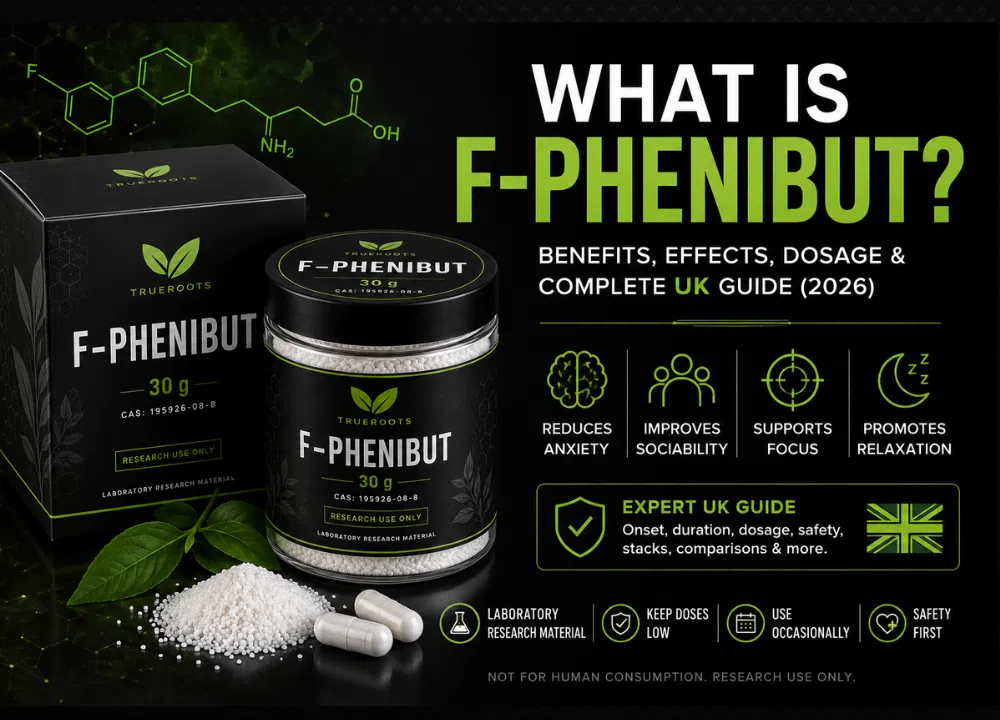
What Is F-Phenibut? Benefits, Effects, Dosage & Complete UK Guide (2026)
7 Jul 2026
What Is F-Phenibut? Benefits, Effects, Dosage & Complete UK Guide (2026)

What is F-Phenibut, how does it work, and is F-Phenibut stronger than Phenibut? These are among the most common questions asked by people researching advanced GABA-B compounds. F-Phenibut (Fluorophenibut) has become increasingly popular because many users report a faster onset, higher potency per milligram, and a cleaner overall experience compared with traditional Phenibut. However, understanding the differences, potential benefits, and risks is essential before considering its use.

Question Quick Answer
What is F-Phenibut? Fluorinated Phenibut analogue
Stronger than Phenibut? Often reported as yes
Onset 60–120 min
Duration 6–10 h
Best use Social confidence
Daily use? No

In this complete UK guide, you’ll learn what F-Phenibut is, how it works, its reported benefits and effects, onset time, duration, half-life, recommended dosage, tolerance, dependence potential, side effects, safety considerations, and current UK legality. We’ll also compare F-Phenibut with Phenibut HCl, Phenibut FAA, Baclofen, and Gabapentin, explain which users may prefer each option, highlight common mistakes, and answer the most frequently asked questions to help you make a more informed decision.

What is F-phenibut Digital illustration of the human brain with neural pathways and artificial intelligence concept representing cognitive enhancement, nootropics, memory, focus, and brain performance.

In This Guide, You’ll Learn Covered
What F-Phenibut is and how it works
Is F-Phenibut stronger than Phenibut?
Benefits, effects and user experiences
Dosage, onset, duration and half-life
Tolerance, withdrawal and safety
F-Phenibut vs Phenibut, Baclofen & Gabapentin
UK legality and buying advice
Expert recommendations and FAQ

What Is F-Phenibut (Fluorophenibut) and How Does It Work?

F-Phenibut, also known as Fluorophenibut, is a chemically modified analogue of Phenibut that contains a fluorine atom attached to the aromatic ring. This small structural modification is believed to influence how the compound is absorbed, distributed, and interacts with the central nervous system. Like traditional Phenibut, F-Phenibut appears to act primarily as a GABA-B receptor agonist, while some researchers and users also suggest limited interaction with alpha-2-delta calcium channel subunits. Although much of the current knowledge comes from user reports and preclinical research rather than large human trials, F-Phenibut has become increasingly popular among experienced users looking for a more predictable alternative to standard Phenibut.

F-Phenibut Pros and Cons at a Glance

Like any GABA-B compound, F-Phenibut offers potential advantages and important limitations. Understanding both sides helps set realistic expectations and supports more informed decision-making before experimenting with any Phenibut analogue.

Advantages Disadvantages
★★★★★ Faster reported onset than Phenibut ★★★★★ Tolerance can develop with frequent use
★★★★★ Higher reported potency per milligram ★★★★★ Dependence risk if used regularly
★★★★☆ Often described as cleaner and more functional ★★★★☆ Limited high-quality human research
★★★★☆ Frequently preferred for daytime use ★★★★☆ Legal status differs between countries
★★★★☆ Lower reported next-day grogginess ★★★★★ Dangerous when combined with alcohol or sedatives

Overall, many experienced users consider F-Phenibut a more predictable alternative to traditional Phenibut for occasional use. However, the reported benefits do not remove the need for conservative dosing, long breaks between sessions, and careful attention to tolerance, dependence, and potential drug interactions.

From a practical perspective, many users report that F-Phenibut produces a quicker onset, greater potency per milligram, and a cleaner overall experience than traditional Phenibut. Commonly reported effects include reduced anxiety, greater social confidence, smoother communication, improved relaxation, and a calmer mental state without the heavier physical sedation that some users associate with higher doses of Phenibut. Individual responses can vary considerably, however, and these observations should not be interpreted as established clinical evidence.

Chemically, the para-fluoro substitution may increase lipophilicity and influence how efficiently the compound crosses the blood-brain barrier. This could help explain why anecdotal reports frequently describe F-Phenibut as acting faster and requiring lower doses than Phenibut HCl. However, robust human pharmacokinetic studies remain lacking, so much of what is currently known is based on preclinical research, theoretical pharmacology, and accumulated user experience rather than definitive clinical data.

Like Phenibut, the primary mechanism of F-Phenibut is thought to involve activation of GABA-B receptors—the same receptor family targeted by prescription Baclofen, although with a different potency and overall effect profile. There is also ongoing discussion of possible alpha-2-delta activity similar to that of Gabapentin, but the significance of this interaction remains uncertain. These combined mechanisms are believed to contribute to the reported anxiolytic, relaxing, and socially facilitating effects that have made F-Phenibut increasingly popular within the nootropics and biohacking communities.

F-Phenibut at a Glance Details
Chemical Name Fluorophenibut (F-Phenibut)
Main Target GABA-B Receptors
Possible Secondary Activity Alpha-2-delta calcium channels
Commonly Reported Effects Calmness, sociability, relaxation, reduced anxiety
Typical User Profile Experienced nootropic users
Evidence Quality ★★★☆☆ Mainly preclinical studies and user reports

Is F-Phenibut Stronger Than Phenibut? Potency, Onset and Duration

One of the most common questions asked by new users is whether F-Phenibut is actually stronger than Phenibut. Based on anecdotal reports and community experience, many users believe that F-Phenibut feels more potent on a milligram-for-milligram basis, produces a faster onset, and delivers a cleaner, more predictable peak. Although controlled human studies comparing the two compounds are limited, this is the pattern most frequently reported within experienced nootropic communities.

F-Phenibut typically begins working within 60–120 minutes, whereas traditional Phenibut often requires 2–4 hours before noticeable effects develop. Many users also describe F-Phenibut as having a shorter overall duration, making it easier to plan around work, social events, or other activities while reducing the likelihood of lingering next-day effects when used responsibly.

Feature F-Phenibut Phenibut
Reported Potency ★★★★★ ★★★★☆
Typical Onset 60–120 minutes 2–4 hours
Reported Duration 6–10 hours 10–24 hours
Daytime Suitability ★★★★★ ★★★☆☆
Next-Day Effects Often reported as milder Can be more noticeable

Individual response varies considerably, which is why there is no universal answer to the question “Is F-Phenibut stronger than Phenibut?” Genetics, body weight, previous GABAergic exposure, metabolism, meal timing, and tolerance can all influence the experience. Many users estimate F-Phenibut to be approximately 1.2–1.5 times stronger than Phenibut HCl on a milligram basis, while others report little difference or even prefer the traditional Phenibut experience. The absence of large clinical trials means these comparisons should be viewed as informed user observations rather than established scientific facts.

Compared with classic Phenibut, F-Phenibut is frequently described as producing a crisper onset, cleaner mental relaxation, and a more functional daytime profile. Many users report reduced anxiety, smoother social interaction, and improved confidence without the heavier body relaxation or prolonged “afterglow” that Phenibut can sometimes produce. Others still prefer traditional Phenibut for its warmer, more sedating character, particularly during evenings or recovery days.

Best Choice If You Want… Recommended Option
Faster onset F-Phenibut
Higher potency per mg F-Phenibut
Longer-lasting relaxation Phenibut
Daytime productivity F-Phenibut
Evening relaxation Phenibut
Lower likelihood of next-day grogginess F-Phenibut (based on user reports)

How to Dose F-Phenibut Safely? Step-by-Step UK Guide

Because potency varies, start at the lowest practical dose. Many UK users try 50–100 mg on an empty or light stomach. Wait 3–4 hours before any redose. Avoid exceeding 250–300 mg in total unless experienced and under medical oversight.

Step-by-step implementation protocol:

  1. Weigh doses precisely on a high-quality 0.001 g scale.
  2. Choose a calm day with absolutely no alcohol or sedative use.
  3. Take 50–100 mg, note the time, and consume a light snack if needed.
  4. Monitor the onset, tracking mood shifts, alignment, or dizziness closely for 4 hours.
  5. Consider a small top-up of 25–50 mg only if strictly required. Many choose to stop here and evaluate the session profile.

Beginner totals often fall between 100–200 mg. Intermediate users sometimes report 150–300 mg. Exceeding 300 mg significantly increases the risk of side effects and tolerance. Avoid daily use and never combine with benzodiazepines, opioids, Z‑drugs, or alcohol. If you’re on prescription CNS depressants, consult a clinician before experimenting. Track F-Phenibut dosage carefully and always err on the side of caution.

Who Should Avoid F-Phenibut?

Although many users report positive experiences with F-Phenibut, it is not appropriate for everyone. Because it primarily acts on GABA-B receptors and influences the central nervous system, certain individuals face a higher risk of adverse effects or drug interactions. If any of the situations below apply to you, speak with a healthcare professional before considering F-Phenibut.

Situation Recommendation
Taking benzodiazepines, opioids or Z-drugs ★★★★★ Avoid combining due to increased CNS depression.
Regular alcohol consumption ★★★★★ Do not combine with F-Phenibut.
History of substance dependence ★★★★★ Higher risk of misuse and dependence.
Pregnancy or breastfeeding ★★★★★ Avoid due to insufficient safety data.
Sleep apnoea or respiratory disorders ★★★★☆ Extra caution is recommended.
Severe depression or other psychiatric conditions ★★★★☆ Consult a healthcare professional before use.
Using prescription CNS-active medication ★★★★☆ Medical advice is recommended before combining.

F-Phenibut is generally discussed as an occasional tool rather than a daily supplement. Most experienced users recommend keeping sessions infrequent, avoiding combinations with other central nervous system depressants, and carefully monitoring individual response. Responsible use, conservative serving sizes, and adequate time between sessions remain the most effective ways to reduce tolerance and unwanted effects.

How to Schedule F-Phenibut and Reduce Tolerance Build-Up

One of the biggest mistakes users make with F-Phenibut is using it too often. While many people focus on finding the “perfect dose,” frequency usually has a much greater impact on both effectiveness and long-term safety. Most problems associated with Phenibut-like compounds develop after repeated use over short periods rather than occasional, well-spaced sessions.

Many experienced users recommend keeping sessions infrequent and allowing plenty of time between uses. Longer breaks help preserve sensitivity, reduce the likelihood of tolerance, and may lower the risk of dependence. Using F-Phenibut on consecutive days or increasing the serving simply because the previous experience felt weaker often produces the opposite of the intended result.

Scheduling Strategy Expert Rating
Occasional use with long breaks ★★★★★
Keeping a consistent routine ★★★★★
Tracking each session ★★★★★
Increasing frequency over time ★☆☆☆☆
Using on consecutive days ☆☆☆☆☆

A practical approach is to reserve F-Phenibut for situations where you genuinely expect to benefit from its reported effects, such as important social events, presentations, or particularly demanding days. On other days, focus on building a strong foundation through quality sleep, regular exercise, good nutrition, hydration, stress management, and recovery. These habits often provide more consistent long-term cognitive and emotional benefits than increasing the frequency of any supplement.

If you notice that the effects seem weaker over time, resist the temptation to increase the amount or shorten the gap between sessions. Instead, extend your break and allow your sensitivity to recover. Chasing the original experience by taking more F-Phenibut is one of the fastest ways to increase tolerance and reduce its usefulness.

Common Causes of Tolerance Risk Level
Frequent use ★★★★★
Increasing the serving regularly ★★★★★
Using on back-to-back days ★★★★★
Ignoring recovery and sleep ★★★★☆
Mixing with other depressants ★★★★★

If you’ve previously used Phenibut frequently, don’t assume you can simply replace it with F-Phenibut at the same serving. Cross-tolerance is considered likely because both compounds share similar pharmacological mechanisms. If dependence has already developed, switching products is unlikely to solve the problem. Seeking medical advice and following a supervised taper is considerably safer than attempting to manage withdrawal independently.

What Benefits and Effects Do Users Report, and When Do They Appear?

Although clinical research on F-Phenibut remains limited, user reports are remarkably consistent in describing its overall effect profile. Most people don’t use F-Phenibut to feel stimulated or euphoric. Instead, they typically seek reduced anxiety, smoother social interaction, improved confidence, and a calmer mental state while remaining functional throughout the day. Many users describe it as producing relaxation without the heavier body sedation sometimes associated with higher doses of traditional Phenibut.

The first noticeable effects are commonly reported within 60–120 minutes, with peak effects usually occurring between 3 and 5 hours after administration. Depending on the individual, many users describe meaningful effects lasting approximately 6–10 hours, followed by a gradual decline. Compared with Phenibut, F-Phenibut is often considered easier to fit into daytime routines because of its faster onset and shorter overall duration.

Reported Effect User Rating
Reduced Anxiety ★★★★★
Improved Sociability ★★★★★
Mental Calmness ★★★★★
Confidence During Social Situations ★★★★☆
Focus & Productivity ★★★☆☆
Physical Relaxation ★★★☆☆

Users frequently report feeling more comfortable during conversations, public speaking, interviews, business meetings, and other situations involving social pressure. Common descriptions include reduced overthinking, smoother conversation, easier eye contact, less mental rumination, improved task initiation, and a greater willingness to engage with other people.

Compared with traditional Phenibut, F-Phenibut is often described as producing a cleaner, more alert experience with less heavy physical relaxation. While some users prefer this more functional profile for daytime use, others continue to favour Phenibut for its warmer, longer-lasting relaxation, particularly in the evenings or on recovery days.

Typical Timeline What Users Commonly Report
0–60 minutes Little or no noticeable effect
60–120 minutes First signs of relaxation and reduced anxiety
3–5 hours Peak effects for confidence, sociability and calmness
6–10 hours Gradual decline in effects
Next Day Usually minimal after-effects when used responsibly

Like any GABAergic compound, F-Phenibut can also produce unwanted effects, particularly when used too frequently or in excessive amounts. Reported side effects include lethargy, dizziness, nausea, irritability, impaired coordination, and cognitive fog. Some users also describe rebound anxiety or disrupted sleep following higher or repeated use. Keeping sessions infrequent, avoiding alcohol and other central nervous system depressants, staying hydrated, and allowing adequate recovery time are among the most commonly recommended strategies for reducing these risks.

How Does F-Phenibut Compare with Phenibut HCl, FAA, Baclofen and Gabapentin?

F-Phenibut is often compared with Phenibut HCl, Phenibut FAA, Baclofen, and Gabapentin because these compounds influence similar neurological pathways but differ significantly in potency, duration, intended use, and overall user experience. Although F-Phenibut and Phenibut share the same primary GABA-B receptor activity, many experienced users report noticeable differences in onset, intensity, and functionality.

Compared with traditional Phenibut, F-Phenibut is frequently described as acting faster, feeling cleaner, and producing a more functional daytime experience. Phenibut HCl is generally associated with a slower onset and longer-lasting relaxation, while Phenibut FAA offers similar effects and is often preferred by users seeking a less acidic formulation. Baclofen and Gabapentin are prescription medicines developed for different medical conditions and should never be viewed as direct recreational or nootropic alternatives.

Compound Main Target Typical User Experience Best Suited For
F-Phenibut GABA-B Faster onset, cleaner relaxation, more functional Social situations and daytime use
Phenibut HCl GABA-B Longer-lasting, warmer, heavier relaxation Occasional relaxation
Phenibut FAA GABA-B Similar to HCl but less acidic Users sensitive to HCl
Baclofen GABA-B Prescription muscle relaxant Medical treatment only
Gabapentin Alpha-2-delta Different neurological profile Prescription use only

One of the biggest practical differences is the onset and overall duration. Many users report that F-Phenibut begins working more quickly than Phenibut HCl and produces a more predictable peak, making it easier to schedule around work, meetings, or social events. Traditional Phenibut, by comparison, is often described as developing more gradually but lasting considerably longer.

Feature F-Phenibut Phenibut HCl Phenibut FAA
Reported Onset 60–120 min 2–4 hours 1–3 hours
Reported Duration 6–10 hours 10–24 hours Similar to HCl
Per-mg Potency ★★★★★ ★★★★☆ ★★★★☆
Daytime Suitability ★★★★★ ★★★☆☆ ★★★☆☆
Next-Day Grogginess Usually lower More commonly reported Moderate

Baclofen is considerably more potent as a prescription GABA-B agonist and is intended for the treatment of muscle spasticity under medical supervision. Gabapentin works differently by targeting alpha-2-delta calcium channel subunits rather than acting primarily on GABA-B receptors. Although these medicines are often mentioned alongside Phenibut compounds, they are not directly interchangeable and should never be substituted without medical advice.

If Your Goal Is… Most Common Choice
Faster onset F-Phenibut
Long-lasting relaxation Phenibut HCl
Less acidic formulation Phenibut FAA
Medical treatment for spasticity Baclofen (prescription only)
Neuropathic pain management Gabapentin (prescription only)
Occasional daytime social confidence F-Phenibut

Ultimately, there is no universally “better” option. F-Phenibut is generally preferred by users seeking a quicker, cleaner, and more functional experience, while traditional Phenibut remains popular among those looking for longer-lasting relaxation. Prescription medicines such as Baclofen and Gabapentin belong in a completely different category and should only be used under appropriate medical supervision.

In the UK, phenibut‑like compounds are generally covered by the Psychoactive Substances Act. Sales for human consumption are restricted, though personal possession is usually not criminalised. Laws change, and there are nuances, so check current guidance on phenibut UK legality or seek legal advice before buying.

Responsible buying checklist:

  • Look for clear labelling and third‑party testing (COA).
  • Confirm the chemical name and salt form (HCl vs FAA) and verify F‑Phenibut identity.
  • Prefer vendors selling for research use only and avoid those making medical claims.
  • Choose tamper‑evident, child‑safe packaging.
  • Require batch numbers and precise dosing information.
  • Avoid sellers who promote co‑use with alcohol or sedatives.

Some UK users mention specific retailers selling TrueRoots F‑Phenibut. Ensure that any product is marketed for research use only and that it has transparent testing. Do not buy or use for human consumption where prohibited. If unsure, pause and consult a professional.

Frequently Asked Questions

What is F-Phenibut?

F-Phenibut, also known as Fluorophenibut, is a Phenibut analogue that primarily acts as a potent GABA-B receptor agonist. It is frequently researched and discussed by experienced individuals for its potential to support mental calmness, stress management, and improved daytime sociability.

What is F-Phenibut used for?

User reports most frequently mention leveraging F-Phenibut for temporary social confidence, reduced situational anxiety, communication support, and smooth focus during demanding presentations or events.

How does F-Phenibut compare with traditional Phenibut?

Compared to classic Phenibut, F-Phenibut is highly noted for providing a significantly faster onset, higher milligram-for-milligram potency, and a more structured, shorter duration of action.

What is the F-Phenibut dosage for beginners?

Most experienced researchers recommend starting at the lowest baseline, typically between 50 mg and 100 mg, to accurately gauge individual sensitivity before considering any alterations in frequency or scale.

What is the F-Phenibut onset time?

Noticeable effects generally surface within 60 to 120 minutes. Factors like recent food intake, generic individual metabolic rates, and baseline tolerance can cause this timeframe to vary.

What is the typical duration of F-Phenibut?

The primary active window typically lasts around 6 to 10 hours, which is followed by a very smooth and gradual decline back to baseline values.

What is the estimated half-life of F-Phenibut?

While structured human data remains limited, preclinical observations and anecdotal profiles estimate the chemical half-life to sit roughly within the 3.5 to 6.5-hour range.

What is the current UK legal status of F-Phenibut?

In the UK, it falls under the scope of the Psychoactive Substances Act, meaning supply and distribution for direct human consumption are restricted, though simple personal possession remains non-criminalised.

What is F-Phenibut stronger than?

On a per-milligram basis, F-Phenibut is structurally stronger and has a higher binding affinity to the GABA-B receptor than traditional Phenibut HCl, requiring much lower serving amounts.

Where can I buy F-Phenibut in the UK?

Cross The Limits stocks TrueRoots F-Phenibut alongside one of the UK’s largest selections of advanced nootropics, cognitive supplements, and performance-focused products.

Expert Ratings: How Does F-Phenibut Perform?

Based on currently available research, pharmacology, and consistent user reports, the following ratings provide a general overview of how F-Phenibut is commonly perceived. These scores are intended as educational guidance rather than scientific measurements, as individual responses can vary considerably.

Category Rating Comment
Anxiety Relief ★★★★★ One of the most commonly reported benefits.
Social Confidence ★★★★★ Frequently discussed before meetings and social situations.
Mental Calmness ★★★★☆ Often described as relaxing without excessive mental slowing.
Daytime Functionality ★★★★☆ Many users prefer it over traditional Phenibut for daytime use.
Sleep Support ★★★☆☆ Some users report improved sleep, while others prefer earlier dosing.
Potency Per Milligram ★★★★★ Generally considered stronger than Phenibut on a milligram basis.
Tolerance Risk ★★★★★ Can increase rapidly with frequent or consecutive use.
Beginner Friendliness ★★★☆☆ Requires careful dosing and long intervals between sessions.
Overall Research Quality ★★☆☆☆ Human clinical evidence remains limited.

Overall, F-Phenibut is most commonly viewed as a fast-acting GABA-B compound suitable for occasional use by experienced individuals who understand its benefits, limitations, and tolerance potential. Conservative dosing and responsible use remain far more important than pursuing stronger effects.

Summary: Should You Consider F-Phenibut?

So, what is F-Phenibut, and is it the right choice for you? Based on current evidence and extensive user experience, F-Phenibut appears to offer a faster onset, greater potency per milligram, and a cleaner, more functional effect profile than traditional Phenibut. However, these advantages do not eliminate the risks associated with GABA-B compounds. Responsible use, conservative serving sizes, and long breaks between sessions remain the most important factors for reducing tolerance and dependence.

The majority of reported problems come from frequent use rather than occasional, well-planned sessions. Increasing the serving, using F-Phenibut on consecutive days, or combining it with alcohol, benzodiazepines, opioids, or other central nervous system depressants significantly increases the likelihood of unwanted effects. If your goal is daily anxiety management or long-term treatment, F-Phenibut should not replace appropriate medical care.

Our Expert Assessment Rating
Relaxation ★★★★☆
Social Confidence ★★★★★
Mental Calmness ★★★★★
Daytime Functionality ★★★★☆
Tolerance Risk (Frequent Use) ★★★★★
Beginner Friendliness ★★★☆☆

Common Mistakes to Avoid

The most common mistakes include redosing before the full effects have developed, increasing the serving too quickly, using F-Phenibut on consecutive days, mixing it with alcohol or prescription sedatives, and treating it as a daily supplement rather than an occasional tool. These habits are far more likely to contribute to tolerance and dependence than responsible, infrequent use.

Storage and Handling

Store F-Phenibut in a cool, dry place away from direct sunlight and moisture. Keep the container tightly sealed and out of reach of children and pets. Always check the product before use and avoid using it if packaging appears damaged or the contents have changed noticeably.

Who May Prefer F-Phenibut?

User Type Suitable?
Occasional social users ★★★★★
Public speakers ★★★★☆
Professionals under occasional pressure ★★★★☆
Daily anxiety management ★☆☆☆☆
People using CNS depressants ☆☆☆☆☆

If you’re considering F-Phenibut, start conservatively, keep detailed notes, and evaluate your response over time rather than chasing stronger effects. Many experienced users find that less frequent use produces the most consistent long-term results.

Cross The Limits stocks TrueRoots F-Phenibut alongside one of the UK’s largest selections of advanced nootropics, cognitive enhancers, peptides, and performance supplements. If you’re researching what F-Phenibut is, how it compares with Phenibut, or which advanced nootropics best match your goals, explore our product pages and educational guides to make a more informed decision before purchasing.

You can find F-Phenibut here: F-Phenibut

KR
About the author

Konrad Rogowski – Founder of Cross The Limits

Previous Next

Pokaż