
Methylene Blue UK: Benefits, Dosage, Focus, Longevity & Safety Guide (2026)
Key Takeaways
- Methylene blue is a redox-active compound with established medical uses and growing interest in mitochondrial function, cognition and biohacking.
- Its proposed cognitive effects are linked mainly to mitochondrial electron transport, cellular energy production and redox balance rather than conventional stimulant activity.
- Methylene blue has important safety considerations, particularly interactions with serotonergic medicines and the risk of haemolysis in people with G6PD deficiency.
- Evidence for long-term nootropic and longevity use remains limited, so potential benefits should be weighed against interactions, product quality and individual health factors.
Methylene blue is a redox-active compound with established medical applications that has attracted growing interest for mitochondrial support, cognitive performance, focus and healthy ageing. Originally developed as a dye, it can participate in cellular electron-transfer processes and cross the blood-brain barrier, which helps explain why it is now widely discussed in biohacking, mitochondrial health and nootropics.
Interest continues to grow among students, professionals, athletes and longevity enthusiasts looking for ways to support mental clarity, attention, memory and cellular energy production. This guide explains what methylene blue does, its proposed mechanism of action, potential cognitive and mitochondrial benefits, safety considerations, interactions, common stacking discussions and what UK users should understand before considering it.
What Is Methylene Blue and How Does It Work?
Methylene blue is a synthetic thiazine dye that can act as a cellular redox mediator, transferring electrons between oxidised and reduced forms. This ability has made it particularly interesting in research involving mitochondrial respiration, oxidative stress and cellular energy production.

You can think of methylene blue as a potential electron “bridge”. In its oxidised and reduced forms, it can participate in electron-transfer reactions associated with cellular respiration. This has led researchers to investigate whether it may influence mitochondrial efficiency under particular conditions.
The compound can also cross the blood-brain barrier. That characteristic has contributed to interest in its potential effects on memory, cognition and neuronal energy metabolism.
Methylene blue also has established clinical uses, including the treatment of methemoglobinemia, but medical use should not be confused with experimental nootropic supplementation. Formulation, purity, route of administration and intended use can differ substantially between medical and consumer contexts.
For broader background on compounds used to support cognition, read our guide to nootropics and support for the brain.
| Category | Quick Overview |
|---|---|
| Type | Redox-active compound |
| Primary Research Interest | Mitochondrial function and cellular energy metabolism |
| Cognitive Interest | Focus, memory, mental clarity and fatigue |
| Popular Among | Biohackers, students, professionals and longevity enthusiasts |
| Key Mechanism | Electron transfer and redox activity |
What Should You Look for When Evaluating Methylene Blue Products in the UK?
Product quality is especially important with methylene blue because industrial, aquarium and laboratory-grade dyes are not interchangeable with products manufactured to pharmaceutical standards. Identity, purity, contamination and manufacturing controls matter considerably.
When evaluating a product, look for transparent analytical documentation that identifies the tested batch and provides information about purity and contaminants. Independent laboratory testing is more meaningful when the certificate can be matched to the actual lot being sold.
Methylene blue also has medical uses, so its regulatory position should not be confused with that of an ordinary dietary supplement. Product descriptions such as “research reagent” or “not for human consumption” should be taken literally rather than interpreted as indirect approval for self-administration.
Useful quality indicators include:
- clear identification of the compound and batch;
- transparent purity testing;
- testing for relevant contaminants;
- appropriate packaging and storage information;
- clear concentration information where solutions are involved;
- traceable manufacturing or laboratory documentation.
Online availability does not establish pharmaceutical quality, suitability for human use or regulatory approval.
| Goal | Level of Interest in Methylene Blue Discussions |
|---|---|
| Focus & Concentration | High |
| Productivity | High |
| Mental Clarity | High |
| Memory Support | Moderate to High |
| Longevity | Moderate to High |
| Workout Performance | Moderate |
| Muscle Growth | Low |
Is There a Safe Methylene Blue Dosage for Cognitive Use?
There is no universally established safe nootropic dosage of methylene blue for healthy people, and medical dosing should not be repurposed into a self-directed biohacking protocol. Appropriate amounts depend on the medical indication, formulation, route of administration, individual health status and potential interactions.
Online discussions frequently refer to “low-dose” or “microdose” approaches, but these terms are not standardised. Product concentration can also vary, making volume-based instructions particularly vulnerable to dosing errors.
Methylene blue is pharmacologically active and can inhibit monoamine oxidase A. This creates important interaction risks with serotonergic medication and means that dose escalation should not be treated like adjusting an ordinary vitamin or sports supplement.
Anyone considering methylene blue should first review medications, G6PD status and relevant medical conditions with a qualified healthcare professional.
| Methylene Blue UK Quick Facts | Details |
|---|---|
| Common Research Interest | Focus, productivity, mitochondrial function and longevity |
| Dosage | No universally established nootropic dose |
| Onset | Depends on formulation and individual response |
| Duration | Subjective effects may last several hours |
| Important Interaction Area | Serotonergic medicines and other monoamine-active substances |
| Important Screening Consideration | G6PD deficiency |
Why Is Methylene Blue Discussed for Focus and Productivity?
Interest in methylene blue for focus is based mainly on its effects on cellular energy metabolism rather than on a traditional stimulant mechanism. The idea is that supporting mitochondrial electron transport may help neurons meet the energy demands of cognitively intensive tasks.
Users often discuss perceived improvements in mental clarity, sustained attention and resistance to cognitive fatigue. However, subjective productivity improvements are difficult to separate from expectations, sleep, caffeine intake and changes in work structure.
A better way to evaluate any cognitive intervention is to define measurable outcomes such as completed work blocks, error rates, recall performance or task completion time.
For a broader explanation of cognitive combinations and smart stacking, explore our guide to nootropics, focus, sleep and smart stacks.
| User Type | Why Methylene Blue May Attract Interest |
|---|---|
| Students | Learning, mental stamina and focus |
| Entrepreneurs | Productivity and sustained cognitive work |
| Programmers | Long analytical work sessions |
| Office Workers | Concentration and mental fatigue |
| Biohackers | Mitochondrial and cognitive experimentation |
| Longevity Enthusiasts | Cellular energy and ageing research |
| Athletes | Interest in mitochondrial function and energy metabolism |
Can Methylene Blue Be Combined With Other Supplements?
Methylene blue is often discussed alongside mitochondrial and cognitive supplements, but combining several active compounds makes both benefits and side effects harder to interpret. Common discussions include omega-3 fatty acids, magnesium, creatine, CoQ10, PQQ, choline sources and NAD+ support supplements.
These combinations are usually based on the idea of supporting different components of energy metabolism. Creatine supports cellular energy buffering, CoQ10 participates in mitochondrial electron transport, and choline sources are used in cognitive stacks for acetylcholine-related pathways.
That does not mean every combination is clinically validated. The more ingredients a stack contains, the harder it becomes to identify the cause of improvements, adverse effects or interactions.
How Does Methylene Blue Compare With NAD+ Support?
Methylene blue and NAD+ support compounds target related but distinct aspects of cellular metabolism. NAD+ participates in redox reactions and cellular signalling, while methylene blue can act as an alternative redox-active electron carrier.
Methylene blue and NAD+ boosters should therefore not be treated as interchangeable compounds, even though both are frequently discussed in mitochondrial and longevity communities.
What About Alpha GPC and Methylene Blue?
Alpha GPC and methylene blue are sometimes discussed together in cognitive contexts because they target different pathways. Alpha GPC supplies choline for acetylcholine synthesis, while methylene blue is discussed primarily for mitochondrial energy metabolism.
Combining mechanistically different compounds does not automatically create useful synergy. People taking prescription medicines or other cognitively active substances should consider potential interactions before experimenting with multi-ingredient stacks.
What Are the Potential Benefits of Methylene Blue for Cognition and Longevity?
The main areas of interest are mitochondrial respiration, cellular energy metabolism, memory, mental fatigue and neuronal resilience, but the strength of evidence differs considerably between these claims.
Preclinical research and small human studies have contributed to interest in methylene blue for cognitive performance. Proposed mechanisms include changes in mitochondrial respiration, redox balance and neuronal energy availability.
In experimental models involving neurodegeneration or metabolic stress, methylene blue has also been investigated for its effects on mitochondrial function and neuronal survival. These findings help explain why the compound appears frequently in longevity discussions.
However, evidence from laboratory models should not automatically be interpreted as proof that long-term use improves healthy human ageing.
For other cognitive-support approaches, browse our brain support category or read our article Brain Booster: Discover Support for Your Brain.
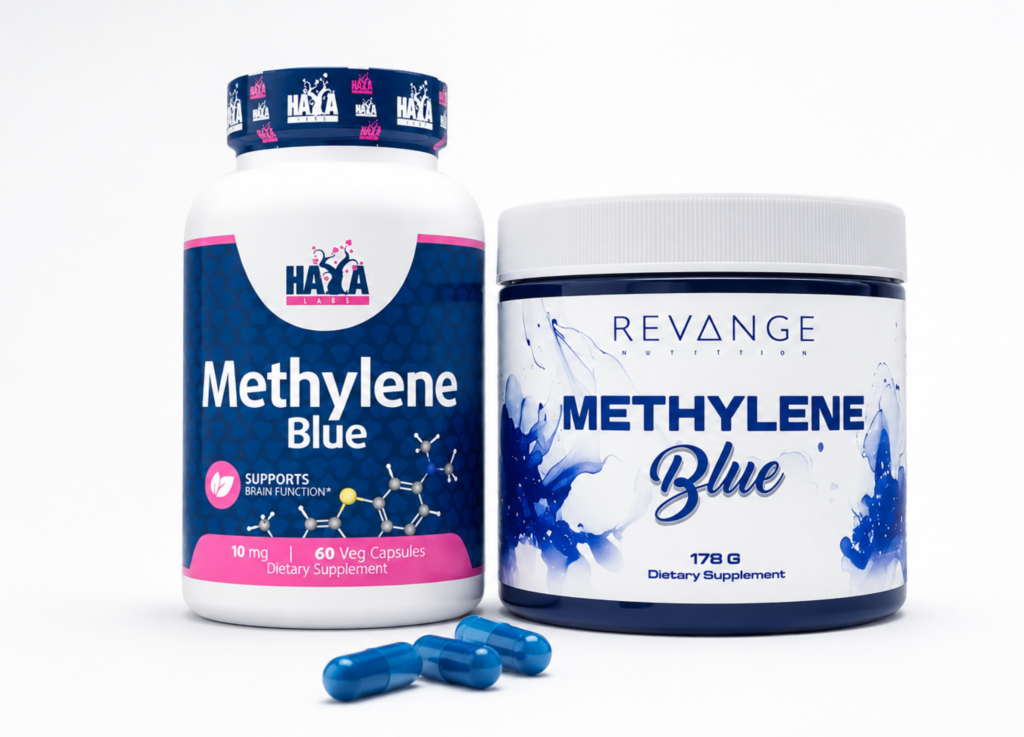
Cross The Limits currently carries both single-ingredient and multi-ingredient methylene blue products. Haya Labs Methylene Blue is positioned as a simpler single-ingredient option, while Revange Nutrition Methylene Blue combines methylene blue with additional cognitive-performance ingredients such as Alpha GPC and Acetyl L-Carnitine.
The presence of additional ingredients can make a formula more convenient, but it also makes it more difficult to determine which component is responsible for either benefits or side effects.
| Combination | Why It Is Discussed |
|---|---|
| Methylene Blue + Alpha GPC | Cognitive and acetylcholine-related support |
| Methylene Blue + ALCAR | Mitochondrial and cellular energy support |
| Methylene Blue + Creatine | Cellular energy metabolism |
| Methylene Blue + CoQ10 | Mitochondrial function |
| Methylene Blue + PQQ | Longevity and mitochondrial discussions |
| Methylene Blue + Caffeine | Productivity discussions, with greater stimulation risk |
What Are the Side Effects and Risks of Methylene Blue?
The most important methylene blue risks involve medication interactions, G6PD deficiency and the fact that higher exposure can produce very different pharmacological effects from the low-dose effects discussed in biohacking communities.
Commonly reported effects include blue or green urine, temporary staining of the tongue or mouth, nausea, headache, dizziness and changes in sleep or alertness.
More serious concerns include serotonin toxicity when methylene blue is combined with certain serotonergic medicines. This is especially important because methylene blue has monoamine oxidase-inhibiting activity.
G6PD deficiency is another important contraindication because methylene blue can increase the risk of haemolysis in susceptible individuals.
Anyone taking antidepressants or other serotonergic medication should not assume that a low methylene blue dose eliminates the interaction risk. Medication combinations should be reviewed by a qualified healthcare professional.
Pregnancy, breastfeeding, kidney or liver impairment and relevant neurological or cardiovascular conditions also require professional medical guidance.
Methylene blue can interfere with some monitoring and laboratory measurements, which is another reason healthcare professionals should know about exposure when interpreting test results.
What Are the Most Common Methylene Blue Mistakes?
The most serious mistakes involve using unsuitable grades of methylene blue, ignoring medication interactions and assuming that higher exposure produces greater cognitive benefits.
- Using aquarium, textile or industrial dye rather than an appropriately manufactured product.
- Assuming online “microdosing” protocols are medically validated.
- Ignoring serotonergic medication interactions.
- Failing to consider G6PD deficiency.
- Combining several stimulatory or cognitively active compounds at once.
- Using late in the day despite sleep disruption.
- Assuming colour changes in urine or saliva are the only relevant side effects.
- Continuing use despite headaches, agitation, unusual mood changes or other adverse effects.
Another common problem is changing several variables simultaneously. If methylene blue, caffeine intake, sleep schedule and other nootropics all change at once, it becomes almost impossible to judge which factor caused the result.
How Do Single-Ingredient and Multi-Ingredient Methylene Blue Products Differ?
Haya Labs Methylene Blue and Revange Nutrition Methylene Blue illustrate two different formulation approaches. One is designed around methylene blue as the primary active compound, while the other combines it with additional ingredients used in cognitive and performance supplements.
A single-ingredient product offers greater control over variables, while a combined formula offers convenience at the cost of making individual ingredient effects harder to separate.
Haya Labs Methylene Blue is a simpler formula centred on methylene blue itself. This type of formulation is easier to evaluate because fewer active ingredients are involved.
Revange Nutrition Methylene Blue combines methylene blue with additional cognitive-performance ingredients such as Alpha GPC, Acetyl L-Carnitine and Citrulline Malate. This makes it closer to a complete nootropic formula than a single-ingredient methylene blue product.
| Feature | Haya Labs Methylene Blue | Revange Nutrition Methylene Blue |
|---|---|---|
| Formulation Type | Primarily single ingredient | Multi-ingredient formula |
| Alpha GPC | No | Yes |
| ALCAR | No | Yes |
| Citrulline Malate | No | Yes |
| Easy to Isolate Individual Effects | Higher | Lower |
| Convenience as a Combined Formula | Lower | Higher |
Summary: What Should You Know About Methylene Blue UK?
Methylene blue is a pharmacologically active redox compound with established medical uses and intriguing mitochondrial properties, but it should not be treated like an ordinary wellness supplement.
Its ability to participate in electron-transfer pathways and cross the blood-brain barrier explains why researchers and biohackers are interested in its potential effects on mental clarity, memory, cellular energy and mitochondrial function.
At the same time, many longevity and cognitive claims remain based on preliminary, preclinical or limited human evidence. Long-term outcomes in healthy users are not well established.
The key safety issues are medication interactions, particularly with serotonergic drugs, G6PD deficiency, appropriate product quality and avoiding the assumption that more methylene blue means better cognitive performance.
Anyone interested in mitochondrial or cognitive support should also consider the basics first: quality sleep, regular exercise, a nutrient-rich diet, cardiovascular health and management of underlying nutritional deficiencies.
For a wider range of everyday health-support options, explore our general health category.
FAQ
Does methylene blue cross the blood-brain barrier?
Yes. Methylene blue can cross the blood-brain barrier, which is one reason researchers have investigated its effects on neuronal energy metabolism, memory and cognitive function.
What is leucomethylene blue?
Leucomethylene blue is the reduced form of methylene blue. The compound can cycle between oxidised and reduced states, allowing it to participate in electron-transfer reactions.
How quickly does methylene blue work?
Onset varies according to formulation, route of administration and individual response. User reports often describe effects within the first few hours, but there is no universal nootropic onset time.
Can methylene blue increase ATP production?
Methylene blue can participate in mitochondrial electron-transfer pathways, which is why it has been investigated for effects on cellular energy metabolism. This does not mean that supplementation reliably increases ATP or performance in every healthy user.
Why can methylene blue turn urine blue or green?
Colour changes can occur because methylene blue and its metabolites are excreted from the body. Blue or green urine is a recognised effect and is not by itself evidence that the compound is working cognitively.
Can methylene blue be used every day?
Long-term nootropic use has not been established as universally safe. Methylene blue is pharmacologically active, so frequency and duration should not be determined solely from online biohacking protocols.
What is the half-life of methylene blue?
Published pharmacokinetic estimates vary considerably according to formulation, route, dose and population. Subjective cognitive effects may disappear before the compound is fully eliminated.
Does methylene blue support mitochondrial health?
Mitochondrial function is one of the main research areas associated with methylene blue because of its redox activity and ability to participate in electron-transfer processes.
How does methylene blue differ from NAD+ boosters?
Methylene blue acts as a redox-active electron carrier, while NAD+ boosters aim to influence the availability of NAD+ involved in cellular metabolism and signalling. They affect related areas of mitochondrial biology through different mechanisms.
Can methylene blue be combined with Alpha GPC?
The combination is discussed in nootropic communities because the compounds target different pathways, but evidence for the combination is limited. Potential interactions with medications and other active compounds still need to be considered.
What is methylene blue used for medically?
Methylene blue has several medical applications, including treatment of methemoglobinemia. Clinical use involves medical-grade preparations and professional dosing rather than consumer biohacking protocols.
Why is methylene blue popular in longevity circles?
Interest comes primarily from research on mitochondrial function, redox balance, oxidative stress and neuronal energy metabolism. These mechanisms are scientifically interesting, but long-term evidence for extending healthy human lifespan remains limited.