SARMs UK 2026: Complete Guide to Every SARM, Expected Effects, Cycle Length & Recovery
3Sep 2026
Key Takeaways
SARMs are investigational compounds that selectively interact with androgen receptors, but they are not approved medicines for general human use in the UK.
Ostarine, RAD-140, LGD-4033 and Andarine are commonly compared for different goals, while MK-677 and Cardarine are often grouped with SARMs despite belonging to different pharmacological classes.
Expected effects and risks vary considerably between compounds, making health monitoring, recovery and realistic expectations more important than simply choosing the most potent option.
Training quality, nutrition, sleep and recovery remain the primary foundations of muscle growth, strength and body composition regardless of supplementation.
SARMs UK 2026: Complete Guide to Every SARM, Expected Effects, Cycle Length & Recovery provides a structured overview of the most commonly discussed selective androgen receptor modulators, their differences, potential effects, risks and recovery considerations. There is no single “best” SARM because Ostarine, RAD-140, LGD-4033, Andarine and more advanced compounds have different characteristics and research profiles. This guide explains how they compare, which compounds are not actually SARMs, and what users should understand before making decisions about investigational performance-enhancing substances.
Quick Answer
SARMs, or Selective Androgen Receptor Modulators, are investigational compounds designed to interact selectively with androgen receptors in tissues such as muscle and bone, but they are not approved medicines for general human use in the UK.
There is no single “best” SARM. Ostarine is commonly discussed in relation to body recomposition, LGD-4033 to muscle gain, RAD-140 to strength and Andarine to cutting, although evidence and safety profiles differ considerably between compounds.
Whether the goal is muscle growth, strength, preservation of lean mass or understanding body recomposition, SARMs should be evaluated according to evidence, potential adverse effects and individual health considerations rather than marketing claims.
Which SARM Is Commonly Associated With Each Training Goal?
Instead of asking which SARM is the strongest, it is more useful to understand why different compounds are associated with different objectives. Muscle gain, fat loss, strength, endurance and body recomposition involve different priorities.
Matching a compound to a goal does not make its use safe, and differences in available evidence, adverse effects and individual response remain important regardless of the intended objective.
Goal
Most Commonly Compared Compound
Typical Community Discussion
First-time research
Ostarine (MK-2866)
Lean muscle and recomposition
Lean bulk
LGD-4033
Size and fullness
Strength
RAD-140
Strength and dense muscle
Cutting
Andarine (S4)
Muscle preservation
Endurance
Cardarine*
Cardio and work capacity
Advanced compound research
S23 / YK-11
Greater potency and suppression concerns
💡 Did You Know?
Although dozens of SARMs have been developed, bodybuilding and fitness discussions tend to concentrate on a relatively small group. Ostarine, RAD-140, LGD-4033 and Andarine are among the most frequently compared because they are associated with different physique and performance objectives.
More advanced compounds such as S23, ACP-105 and YK-11 are generally discussed in the context of greater potency and more demanding recovery considerations. Meanwhile, MK-677 and Cardarine are frequently mentioned alongside SARMs despite belonging to different pharmacological classes.
Mechanism of action, available research, health risks and recovery requirements provide a more meaningful basis for comparison than simply searching for the “strongest” compound.
What Are SARMs?
Selective Androgen Receptor Modulators are investigational compounds developed to interact selectively with androgen receptors. They have been researched in connection with muscle and bone tissue, which is why they have attracted attention in bodybuilding discussions about lean muscle, strength and body composition.
At the molecular level, SARMs act as selective androgen receptor agonists. Different compounds vary in receptor selectivity, pharmacokinetics, potency and the amount of human research available.
These differences mean that expected effects, adverse effects and hormonal impact cannot be assumed to be the same across every compound grouped under the SARM label.
Many compounds discussed in this guide remain investigational and are marketed as research chemicals rather than licensed medicines for general human use. Product quality, regulatory status and available safety data can therefore differ considerably.
The practical appeal discussed within fitness communities is straightforward: potential lean muscle retention, strength development and changes in body composition. In practice, however, outcomes are influenced by training, nutrition, recovery, genetics and numerous health factors.
For more background on the fundamentals, read our guide to SARMs, muscle building and cutting.
How Do the Most Popular SARMs Compare?
No rating system can fully represent the benefit-risk profile of an investigational compound, but a high-level comparison can show why different SARMs are discussed for different purposes.
Compound
Muscle Gain Discussion
Strength Discussion
Cutting Discussion
Water Retention
Suppression Concern
Ostarine
⭐⭐⭐
⭐⭐⭐
⭐⭐⭐⭐
⭐
⭐⭐
RAD-140
⭐⭐⭐⭐⭐
⭐⭐⭐⭐⭐
⭐⭐⭐
⭐⭐
⭐⭐⭐⭐
LGD-4033
⭐⭐⭐⭐⭐
⭐⭐⭐⭐
⭐⭐
⭐⭐⭐
⭐⭐⭐⭐
Andarine
⭐⭐
⭐⭐
⭐⭐⭐⭐⭐
⭐
⭐⭐⭐
ACP-105
⭐⭐⭐
⭐⭐⭐⭐
⭐⭐⭐
⭐
⭐⭐⭐
S23
⭐⭐⭐⭐⭐
⭐⭐⭐⭐⭐
⭐⭐⭐⭐
⭐
⭐⭐⭐⭐⭐
How Do SARMs Differ for Bulking, Cutting and Recomposition?
Choosing between SARMs in bodybuilding discussions generally starts with defining one objective. Different compounds are associated with different balances of anabolic activity, muscle retention, body composition changes and hormonal suppression.
For bulking discussions, LGD-4033 and RAD-140 are frequently mentioned because of their association with lean mass and strength. RAD-140 is commonly portrayed as one of the more potent compounds, which also means that health and hormonal considerations should not be overlooked.
During cutting discussions, Andarine is commonly associated with preserving lean tissue while body fat decreases. Cardarine is also frequently mentioned, although it is a PPAR-delta agonist rather than a SARM.
Ostarine is one of the compounds most frequently discussed in relation to body recomposition and preservation of lean mass.
The intended physique goal does not determine whether a compound is appropriate or safe, and the limited clinical evidence available for many SARMs remains an important limitation.
Popular SARMs by Goal
Primary Goal
Most Commonly Discussed Compounds
Typical Community Focus
Lean Bulk
LGD-4033, RAD-140
Muscle size, strength and fullness
Cutting
Andarine (S4), Cardarine*
Muscle preservation and conditioning
Body Recomposition
Ostarine (MK-2866)
Lean muscle and gradual physique changes
Strength
RAD-140
Strength and power discussions
Endurance
Cardarine*
Cardiovascular work capacity
*Cardarine is a PPAR-delta agonist rather than a SARM but is frequently discussed alongside SARMs.
Choosing a compound should never be based solely on gym popularity or social media recommendations. Relevant considerations include training experience, current health, existing laboratory markers, the amount of human research available and the potential for adverse effects.
Nutrition, training quality and sleep remain the largest controllable determinants of physique progress, and no investigational compound can compensate for weak fundamentals.
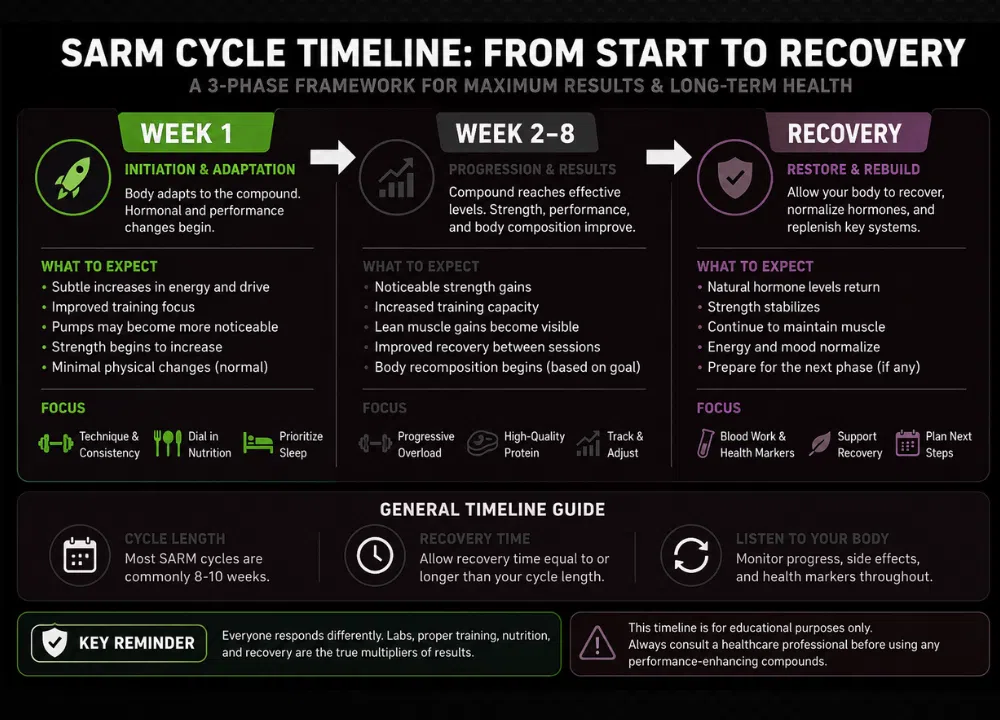
How Long Do SARMs Take to Produce Noticeable Effects?
There is no reliable universal timeline for SARM effects. Compound choice, exposure, training, nutrition, genetics and individual physiology can all influence what a person notices and when.
Community reports often describe performance-related changes before obvious physique changes. However, these reports are anecdotal and should not be interpreted as predictable clinical outcomes.
RAD-140 is frequently associated in user reports with strength changes, while LGD-4033 is often discussed in connection with body weight and muscle fullness. Ostarine is commonly portrayed as more gradual, while Andarine is often discussed in cutting contexts.
Community reports are not a substitute for controlled clinical evidence, and apparent changes in strength, body weight or appearance do not demonstrate that a compound is safe or effective.
Commonly Reported Timeline in Online Discussions
Period
Changes Commonly Mentioned in User Reports
Early phase
Changes in training performance, pumps, appetite or sleep may be reported.
Following weeks
Strength or recovery changes may become more noticeable in anecdotal reports.
Later phase
Body composition or muscle fullness may become easier to observe if training and nutrition remain consistent.
Extended exposure
Progress may slow while cumulative adverse effects can become a greater concern.
What Influences How Quickly Changes Are Noticed?
Training experience and consistency.
Daily protein and calorie intake.
Sleep quality and recovery.
Individual genetics and physiology.
The specific compound being researched.
Overall health and hormonal status.
SARMs should be viewed as investigational performance modifiers rather than substitutes for effective resistance training, nutrition and recovery.
Is There a Recommended SARM Cycle Length?
There is no medically established safe or universally recommended SARM cycle length for recreational bodybuilding use. Online fitness discussions often refer to defined periods of exposure, but these should not be interpreted as evidence-based medical recommendations.
Different SARMs vary in potency, pharmacokinetics and potential hormonal impact. Compounds such as Ostarine are often described as milder in community discussions, while RAD-140, LGD-4033, S23 and YK-11 are commonly associated with greater suppression concerns.
Longer exposure does not automatically produce better outcomes. Potential adverse changes in hormonal markers, blood lipids and other aspects of health may accumulate even when visible progress has slowed.
Anyone concerned about exposure to SARMs or other investigational performance-enhancing compounds should discuss appropriate laboratory testing and follow-up with a qualified healthcare professional rather than relying on a generic online cycle schedule.
How Do SARMs Compare With Anabolic Steroids?
SARMs and anabolic steroids both interact with androgen-related pathways, but SARMs were developed with greater tissue selectivity in mind. This does not mean that SARMs are free from systemic effects or hormonal suppression.
A common misconception is that extending exposure automatically produces proportionally better results. In reality, physical progress can become more gradual while unwanted changes in hormonal, cardiovascular or metabolic markers may continue.
Greater exposure can increase cumulative health concerns even when visible physique improvements begin to plateau.
Why Does Recovery Matter?
Recovery should be considered part of the health discussion surrounding any suppressive performance-enhancing compound. Relevant factors can include hormonal markers, lipid levels, blood pressure, mood, sleep, libido and overall wellbeing.
Products aimed at general cycle support are available as a category, but supplementation should not be viewed as a substitute for medical assessment or appropriate laboratory monitoring.
How Do Ostarine, RAD-140, LGD-4033 and Andarine Differ?
There is no single “best SARM” because Ostarine, RAD-140, LGD-4033 and Andarine are associated with different characteristics, levels of research and potential adverse effects.
Ostarine (MK-2866)
Ostarine is frequently described as one of the more approachable SARMs in fitness discussions. It is commonly associated with gradual changes in lean mass and body recomposition rather than dramatic increases in body weight.
RAD-140 (Testolone)
RAD-140 is widely discussed as one of the more potent SARMs for strength-related goals. Community reports commonly mention increases in training intensity and strength, but greater potency also brings greater concern about hormonal suppression and other adverse effects.
LGD-4033 (Ligandrol)
LGD-4033 is commonly associated with lean bulking discussions because of reported changes in muscle fullness, body weight and strength.
Any increase in body weight must be interpreted carefully because changes can reflect several factors, including muscle, glycogen, water and changes in calorie intake.
Andarine (S4)
Andarine is commonly discussed in cutting contexts where preservation of lean mass and visual definition are priorities.
Reports of visual disturbances associated with Andarine are particularly important when evaluating its risk profile. This highlights why investigational compounds should not be assessed solely by their potential physique effects.
Popular Compound Comparison
Compound
Commonly Associated With
Typical Community Discussion
Ostarine (MK-2866)
Recomposition
Lean muscle retention and gradual progress
RAD-140 (Testolone)
Strength and Lean Mass
High training intensity and dense muscle
LGD-4033 (Ligandrol)
Bulking
Muscle fullness and size
Andarine (S4)
Cutting
Muscle preservation and conditioning
Experienced athletes often emphasise that training quality, nutrition, sleep and recovery influence progress more than the choice between individual compounds. Investigational compounds should not be viewed as replacements for these fundamentals.
Are MK-677, Cardarine and SR9009 Actually SARMs?
No. MK-677, Cardarine and SR9009 are frequently discussed alongside SARMs, but they work through different biological pathways and should not be classified as selective androgen receptor modulators.
Compound
Class
Commonly Discussed Goal
MK-677
Growth hormone secretagogue
Appetite, sleep and recovery discussions
Cardarine
PPAR-delta agonist
Endurance and cutting discussions
SR9009
Rev-Erb agonist
Metabolism and endurance research
YK-11
SARM-like compound
Strength and muscle growth discussions
ACP-105
Investigational SARM
Lean mass and strength discussions
S23
Investigational SARM
High potency and suppression concerns
What Is MK-677?
MK-677, also known as Ibutamoren, is not a SARM. It is generally described as a growth hormone secretagogue because it acts on pathways related to growth hormone and IGF-1.
In fitness communities, MK-677 is commonly discussed in connection with appetite, sleep and recovery. Because it does not work through the androgen receptor in the same way as SARMs, its potential effects and adverse effects should be evaluated separately.
Learn more about its mechanism in our guide explaining how MK-677 works and what effects are discussed.
What Is Cardarine?
Cardarine, or GW-501516, is a PPAR-delta agonist rather than a SARM. It is frequently discussed in relation to endurance, work capacity and cutting, but belongs to a fundamentally different pharmacological class.
What Is SR9009?
SR9009 is commonly discussed in relation to Rev-Erb receptors and pathways associated with metabolism and circadian biology. Limited human evidence and questions around oral bioavailability make extrapolation from preclinical findings particularly uncertain.
What About YK-11, ACP-105 and S23?
YK-11, ACP-105 and S23 are generally discussed as more advanced or potent investigational compounds. Community conversations often associate them with strength, lean mass or cutting.
The comparatively limited human evidence available for these compounds makes confident claims about effectiveness, safe exposure or long-term health consequences especially difficult.
How Do These Compounds Compare by Goal?
Goal
Compounds Commonly Discussed
Important Note
Bulking
MK-677, LGD-4033, RAD-140
MK-677 is not a SARM
Cutting
Cardarine, Andarine, S23
Cardarine is not a SARM
Endurance
Cardarine, SR9009
Different pharmacological classes
Recomposition
Ostarine, MK-677, ACP-105
Evidence and risks differ
Advanced strength discussions
RAD-140, YK-11, S23
Greater potency may bring greater risk
The key lesson is that not every research compound used in bodybuilding conversations should be grouped under the term “SARM”. Mechanism matters because it influences potential effects, adverse effects and the type of clinical evidence needed to evaluate a compound.
Which Health Markers Matter After SARM Exposure?
Health monitoring should be considered before problems appear. Depending on the compound and individual circumstances, a healthcare professional may consider hormonal, cardiovascular, liver, kidney and haematological markers when evaluating health after exposure to performance-enhancing compounds.
Laboratory testing is more informative than attempting to judge hormonal recovery from gym performance, mood or appearance alone.
Commonly Discussed Health Markers
Marker
Why It May Be Relevant
Testosterone
Helps assess androgen status
LH / FSH
Provides information about pituitary signalling
SHBG
Helps interpret androgen measurements
Lipid Profile
Tracks HDL, LDL and cardiovascular risk markers
Liver Enzymes
Provides information about potential liver stress
Kidney Markers
Helps assess kidney function
Full Blood Count
Reviews red cells, white cells and platelets
Blood Pressure
Important cardiovascular health indicator
The appropriate tests and timing depend on individual circumstances and should be determined with a qualified healthcare professional.
Training and nutrition during recovery should also avoid unnecessary additional stress. Adequate sleep, appropriate calorie intake and manageable training volume remain important while health markers are being assessed.
Those exploring general nutritional products related to this area can view our hormone balance category, although supplements should not be treated as a replacement for medical assessment.
What Are the Most Common SARM Mistakes?
Many disappointing or risky experiences described in SARM communities involve poor planning, unrealistic expectations or weak training fundamentals. Common mistakes include choosing a compound based on popularity, using several compounds simultaneously, ignoring adverse effects and relying on anecdotal advice instead of objective health monitoring.
Changing multiple variables at the same time makes it difficult to determine what is causing either progress or unwanted effects.
Another major mistake is ignoring recovery. Sleep quality, calorie intake, hydration, stress management and sensible training progression all influence long-term physical development.
Most Common Mistakes at a Glance
Mistake
Potential Consequence
Choosing a compound based only on popularity
Unrealistic expectations and poor risk assessment
Using multiple compounds simultaneously
Difficult to identify effects or side effects
Extending exposure because progress slows
Greater cumulative health concerns
Skipping medical monitoring
Lack of objective health information
Ignoring nutrition
Reduced ability to evaluate physique changes
Poor sleep and recovery
Lower performance and poorer wellbeing
Increasing training volume while fatigued
Higher injury and overreaching risk
Following social media instead of evidence
Poor decision-making and unrealistic expectations
What Practices Support Better Long-Term Results?
Well-structured training, adequate nutrition, consistent sleep and realistic expectations remain more important for sustainable progress than chasing increasingly potent compounds.
Best Practice
Why It Helps
Define one clear training goal
Creates more realistic expectations
Track objective progress
Makes trends easier to evaluate
Monitor general health
Provides feedback beyond physique changes
Use appropriate recovery periods
Reduces accumulated training stress
Prioritise sleep and nutrition
Supports normal training adaptations
Seek medical advice when health markers change
Allows concerns to be assessed appropriately
Rather than thinking only in terms of “strong” or “weak” compounds, focus on the complete performance strategy. Cross The Limits also groups products by broader performance goals for users researching sports nutrition.
Who Should Not Consider SARMs?
SARMs are investigational compounds with unresolved safety questions and are particularly inappropriate for several groups.
Anyone under 18.
Pregnant or breastfeeding women.
People with cardiovascular disease.
Individuals with uncontrolled hypertension.
People with liver disease or significant liver abnormalities.
Competitive athletes subject to anti-doping rules.
Anyone experiencing unexplained hormonal or health problems.
Anyone unable or unwilling to seek appropriate medical advice when adverse effects occur.
Are SARMs Legal in the UK in 2026?
SARMs are not approved medicines for general human use in the UK, and their regulatory position depends on how they are marketed, supplied and intended to be used. Many compounds are sold as research chemicals rather than licensed medicinal products.
This distinction matters because a product sold for laboratory research should not automatically be interpreted as a consumer supplement approved for human use.
SARMs UK 2026 at a Glance
Topic
General Position
Approved medicines for general human use
No
Frequently marketed as research chemicals
Yes
Competitive sport
SARMs are prohibited under anti-doping rules
Product quality
Can vary significantly
Independent laboratory information
Relevant when evaluating product quality claims
Competitive sport is another important consideration. Athletes subject to anti-doping rules should check the current prohibited list because SARMs and several related performance-enhancing compounds can lead to anti-doping violations.
Product quality also deserves attention. Investigational compounds are not equivalent to regulated consumer medicines, and purity or ingredient accuracy may vary.
Anyone researching SARMs in the UK should verify current official regulatory and anti-doping guidance rather than relying on old forum posts or retailer claims.
What Should You Consider Before Researching SARMs?
✔
Question
□
Do I understand what the compound actually is?
□
Have I reviewed the available human research?
□
Do I understand the known and unknown health risks?
□
Is my training and nutrition already well structured?
□
Is my sleep consistent?
□
Do I understand the regulatory and anti-doping implications?
□
Am I prepared to seek medical advice if problems occur?
Summary: What Should You Know About SARMs UK in 2026?
The most important takeaway is that SARMs are investigational performance-enhancing compounds, not ordinary sports supplements, and their potential physique effects must be considered alongside limited evidence and genuine health risks.
Ostarine, RAD-140, LGD-4033 and Andarine are among the compounds most frequently compared, while MK-677, Cardarine and SR9009 belong to different pharmacological classes despite regularly appearing in the same bodybuilding discussions.
Rather than following online hype, compare compounds based on mechanism of action, available human research, known adverse effects and unresolved safety questions. Nutrition, progressive training, sleep quality and consistency continue to have a greater influence on long-term physique development than any individual research compound.
Cross The Limits provides educational content alongside specialist categories including advanced and special-designation products, nootropics and prohormones.
FAQ
Which SARM is commonly discussed by beginners?Ostarine is frequently compared by people researching SARMs for the first time because it is commonly portrayed as having a milder profile than compounds such as RAD-140 or S23. This does not make it risk-free or medically recommended, and individual health considerations remain important.
Which SARMs are commonly discussed for muscle gain?RAD-140 and LGD-4033 frequently appear in discussions about lean mass and strength. Both are investigational compounds, and potential hormonal and metabolic effects should be considered alongside any reported physique benefits.
Which compounds are commonly discussed during cutting?Andarine is often discussed in relation to preservation of lean tissue during cutting. Cardarine is also frequently mentioned, although it is a PPAR-delta agonist rather than a SARM.
How quickly do SARMs produce noticeable changes?There is no universal timeline. Anecdotal reports often describe performance changes before visible physique changes, but individual outcomes depend on the compound, training, nutrition, genetics and numerous other variables.
Do SARMs suppress natural testosterone?Several SARMs have demonstrated or are associated with suppression of the hypothalamic-pituitary-gonadal axis. The magnitude can vary according to the compound and individual circumstances, and laboratory testing provides more useful information than symptoms alone.
What health markers may be relevant after SARM exposure?A healthcare professional may consider testosterone, LH, FSH, SHBG, lipid profile, liver enzymes, kidney markers, full blood count and blood pressure depending on the circumstances. Appropriate testing should be determined individually.
Are MK-677 and Cardarine SARMs?No. MK-677 is a growth hormone secretagogue, while Cardarine is a PPAR-delta agonist. They are frequently discussed alongside SARMs because of their popularity in the same fitness communities, but their mechanisms are different.
Can women use SARMs?Women can face significant hormonal and other health risks from investigational androgen-related compounds. Anyone considering exposure should discuss the potential risks with a qualified healthcare professional rather than relying on general bodybuilding protocols.
Are SARMs legal in the UK?SARMs are not approved medicines for general human use in the UK. Regulatory considerations can depend on how a substance is marketed, supplied and intended to be used, so current official guidance should be checked before purchasing or importing investigational compounds.
Are SARMs prohibited in competitive sport?SARMs are prohibited under anti-doping rules. Competitive athletes should review the current prohibited substance list maintained by their governing anti-doping organisation.
Can SARMs replace proper training and nutrition?No. Progressive resistance training, adequate nutrition, sufficient protein, quality sleep and recovery remain the primary drivers of muscle growth, strength development and body composition.
What is one of the biggest mistakes when researching SARMs?One of the biggest mistakes is relying on anecdotal protocols and social media claims without considering the limited clinical evidence, potential adverse effects and individual health status.
About the author
Cross The Limits
Cross The Limits is a passionate advocate for health, fitness, and well-being. Since 2018, we have been providing top-quality dietary supplements and vitamins across the UK. Based in Suffolk, our team is committed to helping you achieve your fitness goals with trusted products, expert advice, and unwavering support. Through our blog, we share valuable tips, insights, and the latest trends to inspire and guide you on your health and fitness journey.