
Isolate, concentrate or hydrolyzate? Which protein supplement should you choose?
Key Takeaways
- Protein powders supplement the diet: They provide a convenient way to increase protein intake but should not replace varied, nutrient-rich food sources.
- Whey protein concentrate offers good value: WPC is generally affordable, versatile, and suitable for people who tolerate lactose and want an everyday protein supplement.
- Whey protein isolate contains less lactose: WPI usually provides a higher percentage of protein with less fat, carbohydrate, and lactose than concentrate.
- Whey protein hydrolysate is rapidly digested: WPH contains partially broken-down proteins but is usually more expensive and may have a bitter taste.
- Casein digests more slowly: Micellar casein can provide a gradual supply of amino acids, making it a practical option before bed or during a long break between meals.
- Your individual needs should guide the choice: Consider your daily protein target, digestive tolerance, budget, preferred taste, and dietary requirements.
- Total daily intake matters most: Although digestion rates differ, consistently consuming enough protein throughout the day is generally more important than taking a shake immediately after exercise.
 Isolate, concentrate or hydrolyzate? Which protein supplement should you choose?
Protein supplements are the basic and most frequently used supplements for people who regularly train at the gym, as well as those who take up other sports. It allows you to supplement the protein in the diet; if you’re physically active, the demand for them is much more significant. We can distinguish several forms of protein powder, differing mainly in their absorption time and ingredients – the protein content, fat and carbohydrates, and lactose. Which protein supplement is the best for you?
Protein supplements for people with an increased demand for protein
We provide protein to our bodies with food. Its primary sources are dairy and lean meat. High content (27g of protein) can be found in skyr – natural yoghurt (225g of the product), lean curd cheese (160g of the product), and chicken breast (130g of the product). A portion of a protein supplement corresponds to the same protein content, usually 23-27 g, so it should be used additionally only by people with increased physical activity, especially those who train intensively at least 4-5 times a week. People on a reduced diet have a high demand for protein because it protects against the loss of muscle tissue. People who build muscle mass also need it more because it is the basic building block of muscles.
Protein supplements should be treated as a supplement to a wholesome or high-protein diet, and not as a substitute for basic protein sources. Its form should always be adjusted to the point of the day when we consume it and to the effect we want to achieve.
A universal isolate
The protein isolate is marked with the WPI symbol, followed by a number, e.g. WPI90, informing about the protein content in the dry matter of the product. Protein isolates are made using a cross-flow microfiltration process. This enables better separation of carbohydrates and a higher protein content (90g per 100g of protein powder), higher than in a protein concentrate but lower than in a hydrolyzate. The protein isolate also has excellent solubility. In contrast to the concentrate, it contains less sugar and fat, so it may have a slightly worse taste, but the taste is not the main factor when choosing the appropriate protein supplement. What’s much more critical is the absorption time. The isolate is absorbed relatively quickly and should be consumed immediately after training. It is worth taking the conditioner to the gym or preparing it right after returning home from outdoor training.
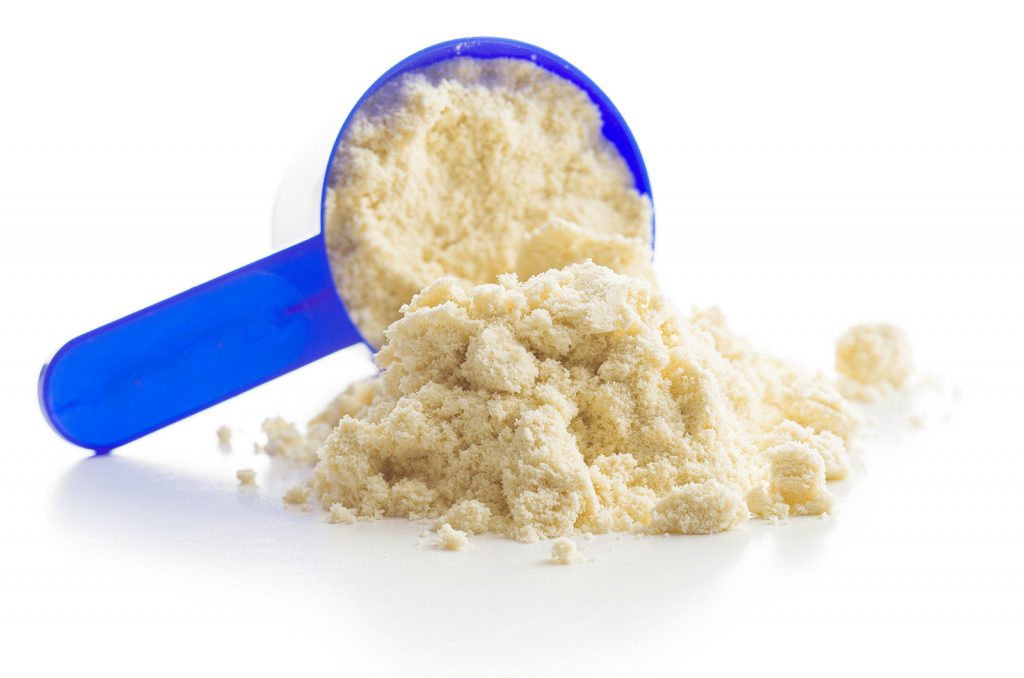
The hydrolysate has the fastest absorption.
Whey protein hydrolysate, i.e. WPH, is considered the highest quality protein supplement, resulting in its slightly higher price. It is produced by hydrolysis of whey protein concentrate or isolation in a water environment. The connections between individual amino acids and peptides that comprise the protein are broken. This causes the hydrolysate to be absorbed very quickly in the digestive tract and, therefore, as in the case of the isolate, it should be used immediately after training. However, during hydrolysis, peptides are released, resulting in the conditioner’s bitter, unpleasant taste. If you don’t like it, you can choose flavoured hydrolysates. Hydrolysates are conditioners recommended especially for people who train very intensively and not only care about a nice figure but also fast muscle regeneration after a workout and better preparation for the next one.
 Concentrates with high carbohydrate content
 Concentrates with high carbohydrate content
 Another form of protein supplement is the WPC concentrate. It is most often chosen by people who are just starting their adventure with intense physical activity or have just started building muscle mass. Its significant advantage is its low price. It is made from cow’s milk whey in the process of micro- or ultrafiltration. Unlike the hydrolysate and isolate, its absorption time is long – it is fully absorbed in about 2-4 hours after consumption. Concentrates usually have a high content of carbohydrates, namely milk sugar (lactose) and sucrose. This means that it is not a good source of protein for people who are lactose intolerant. In addition, due to the long absorption time, we need to consume whey protein concentrate between workouts; it also works well before bedtime. If you are looking for a quick portion of protein to be taken immediately after workouts, this won’t be the best option.
Casein – the best for the night
Recently, micellar casein (MC) has become increasingly popular. Its protein content is comparable to whey protein concentrate – 100g of powder contains approx. 80g of protein. Casein is obtained from milk: it consists of ca. 80% milk protein fractions and 20% whey protein. Casein is used to make curd cheese- a well-known and popular cheese that takes a long time to digest – and so does casein. We eat it at night or when we have a long break between meals, at least 5 hours. During the day, it is unlikely to happen, or at least it should not, as meals should be eaten regularly every 3-4 hours. Casein has a low fat and sugar content, which is the result of a complex production process – microfiltration, evaporation, and drying. It can be used by people who are lactose intolerant because it contains only trace amounts of this sugar. However, you have to be careful with it then.
As there are many types of protein powders with different properties and forms, we can choose the supplement that best suits our needs, goals, training plan, and time of consumption. Immediately after training, we consume isolate or hydrolysate; a concentrate will be taken between training sessions and casein at bedtime.
FAQ
What is the difference between whey concentrate, isolate and hydrolysate?
Which type of protein powder is best for beginners?
Which protein powder is best after a workout?
Is whey protein isolate suitable for people with lactose intolerance?
Is whey protein hydrolysate better than isolate?
When should you take micellar casein?
How should you choose the right protein supplement?
Can protein powder replace protein-rich foods?